• STACKED
  • About Us
  • Categories
    • Audiobooks
    • Book Lists
      • Debut YA Novels
      • Get Genrefied
      • On The Radar
    • Cover Designs
      • Cover Doubles
      • Cover Redesigns
      • Cover Trends
    • Feminism
      • Feminism For The Real World Anthology
      • Size Acceptance
    • In The Library
      • Challenges & Censorship
      • Collection Development
      • Discussion and Resource Guides
      • Readers Advisory
    • Professional Development
      • Book Awards
      • Conferences
    • The Publishing World
      • Data & Stats
    • Reading Life and Habits
    • Romance
    • Young Adult
  • Reviews + Features
    • About The Girls Series
    • Author Interviews
    • Contemporary YA Series
      • Contemporary Week 2012
      • Contemporary Week 2013
      • Contemporary Week 2014
    • Guest Posts
    • Link Round-Ups
      • Book Riot
    • Readers Advisory Week
    • Reviews
      • Adult
      • Audiobooks
      • Graphic Novels
      • Non-Fiction
      • Picture Books
      • YA Fiction
    • So You Want to Read YA Series
  • Review Policy

STACKED

books

  • STACKED
  • About Us
  • Categories
    • Audiobooks
    • Book Lists
      • Debut YA Novels
      • Get Genrefied
      • On The Radar
    • Cover Designs
      • Cover Doubles
      • Cover Redesigns
      • Cover Trends
    • Feminism
      • Feminism For The Real World Anthology
      • Size Acceptance
    • In The Library
      • Challenges & Censorship
      • Collection Development
      • Discussion and Resource Guides
      • Readers Advisory
    • Professional Development
      • Book Awards
      • Conferences
    • The Publishing World
      • Data & Stats
    • Reading Life and Habits
    • Romance
    • Young Adult
  • Reviews + Features
    • About The Girls Series
    • Author Interviews
    • Contemporary YA Series
      • Contemporary Week 2012
      • Contemporary Week 2013
      • Contemporary Week 2014
    • Guest Posts
    • Link Round-Ups
      • Book Riot
    • Readers Advisory Week
    • Reviews
      • Adult
      • Audiobooks
      • Graphic Novels
      • Non-Fiction
      • Picture Books
      • YA Fiction
    • So You Want to Read YA Series
  • Review Policy

Guest Post: Molly Wetta on Reader’s Advisory in the Library and Beyond

October 14, 2013 |

Molly Wetta is YA librarian assistant in Kansas who blogs about books, reading, and librarianship at Wrapped Up in Books. Her blog is a treasure trove of reviews and resources, so if you’re not reading it, it’s one to get in your regular reading rotation. You may recognize Molly’s work or name from some of the amazing graphic-driven reader’s advisory resources that have floated around social media, and I’m thrilled she’s here today to talk about what she does, how she does it, and how you can do it, too, whether you’re a librarian or not. I am a huge fan of it and want to model a lot of these ideas in my own RA work because they’re so great. 


To be honest, the first time someone complimented my “RA skills” I didn’t even know what she meant. Talking to people about books is something that came naturally to me. At the time, I had no formal training. I still feel like I am far from an expert on the topic, but it’s a subject I’m passionate about, so when Kelly asked me to contribute a post on my approach to reader’s advisory, I thought it would be a great opportunity to share my perspective and learn from other’s ideas.


I didn’t take my first library job because I wanted to be a librarian.  I was looking for a part-time position that wouldn’t be too stressful while I got my master’s degree in social work. I envisioned a career in outreach, advocacy, or organizing on behalf of the welfare of women and children.


It just so happened that when I began my search, a position opened up in the young adult section of my local library. I thought it would be fun so I went ahead and applied, even though my only experience working in a library was as a research assistant. I did have experience working with teens, as a high school debate coach and at a group home for children in the state’s care, but I’m pretty sure the reason I got my position was because of my answer to one particular interview question.


That question was, “What would you recommend to a teen looking for a book ‘like The Hunger Games?’” The film based on the popular series was in production, and it had more holds than any other book in the library. In my response, I discussed why recently released Legend by Marie Lu would be a hit with Hunger Games fans. Rather than any formal education, it was my personal reading and experience discussing books with other enthusiastic readers provided me with the foundation of knowledge to be able to answer that interview question.


Reader’s advisory is one of the most important services libraries provide, which is why I think my answer to that particular question weighed as heavily during the interview as my experience with the organization of information in my finance job and my past work with teens. In surveys, patrons continually rate help “finding their next book” as one of the top reasons they use their library. In fact, at least in the young adult section, I get far more requests for helping finding fiction books for pleasure reading than other types of reference inquiries.


Talking to people about books and understanding why people are attracted to the books they love wasn’t a skill set I consciously tried to develop, but there are three factors that I think help me connect readers with the right books: my reading habits, my approach to an in-person RA interview, and my graphic and social philosophy with regards to passive reader’s advisory.


READING HABITS


If you want to get better at reader’s advisory, there’s no way around it: you have to read. And read widely, which most likely means outside your comfort zone and personal interests. Reading reviews and using tools like NoveList and subject headings are great, but I know I’m best able to hand sell a particular title if I’ve actually read it (even if I didn’t personally like it). There’s certain insight that can only be gained from reading a book.


I’m lucky enough to be interested in a wide variety of styles and genres. I love novels by Portuguese novelist José Saramago, who won the Nobel prize in Literature, as much as I love the campy, supernatural mystery series by Charlaine Harris about a telepathic waitress. YA epic fantasy has as much appeal for me as gritty, realistic teen novels, horror, or paranormal romance. I’ve always had eclectic taste.


But my reading habits did change when I started working in a library and reading became essential to my job and not just a personal hobby. I used to read purely for my own pleasure, but now I’m willing to read just about anything. Even if a book is not my personal cup of tea (I prefer coffee), I can usually envision the type of reader who would enjoy it.


Now that I work in a library, I’m conscious about reading a diverse selection across all categories and genres as well balancing new and forthcoming releases with backlists titles. I’ve tried new formats like graphic novels and audiobooks in order to be able to better advise patrons. I keep track of what I read, I take notes about what I read, and I review most of the titles I read. An organized and deliberate approach to my personal reading definitely helps me in my job, even if isn’t a requirement. Writing about what I’ve read helps me remember details and gives me resources to refer back to if my memory is fuzzy.


While most librarians enter the profession because they are at least somewhat passionate about reading, a love of books is not all you need to be able to offer personal suggestions that work for patrons. It’s how you use and apply that knowledge that makes the difference between good reader’s advisory and great reader’s advisory.


READER’S ADVISORY INTERVIEWS


You know what has informed my reader’s advisory style more than any MLIS class? My part-time job my senior year of high school and freshman year of college working at Hot Topic. While the appeal of the job for me at the time was free concert tickets and a discount on band t-shirts, it taught me more than I anticipated about interacting with consumers. Reader’s advisory isn’t that different than retail sales: instead of helping people find the right band t-shirts and costume jewelry that promotes their desired aesthetic, I now help readers find the right “style’ of book. Customer service experience is important for working in the library. If you’re not adept at interacting with people, front line service in a library is not going to be a fun career for you.


Though I do sometimes help adult patrons find books they want, YA or otherwise, most of my interaction is with teen patrons. I think I’m particularly good at talking with this age group because I genuinely like teens. I respect their opinions and enjoy how passionate they can be about what they love. It’s important to make them feel comfortable discussing their interests and let them know that I’ll never judge them for their taste.
It’s easy to recommend books to people who have similar taste to your own, but reader’s advisory isn’t about you—it’s about helping a patron find a book they will like. I suggest titles with a disclaimer and tell them I’ll in no way be offended if they don’t check out the book or if they do and decide they don’t like it. I listen to what they actually want rather than telling them what I think they should want.


I think it’s also important to throw preconceived notions about what someone will like out the window. Too often, they’re wrong. That 6 foot tall, 220 pound 17 year-old linebacker might lover reading historical romance, and the girl who won’t let go of her boyfriend’s hand might be more into sci-fi with robots than contemporary romance.


The first layer of reader’s advisory is finding a book that is “about” what the reader is interested in or in the mood for, but you’re more likely to find a good match if you look beyond subject matter to appeal terms. Anyone can make a list of zombie books. Finding the right zombie book(s) for someone requires a more nuanced approach. Is the reader looking for a funny zombie book, or a dark gothic horror? Something campy or something thought-provoking? It makes a difference.


Often, more casual readers (and especially teenagers) are most likely not going to articulate what they want in their next read in the kind of terms that librarians or especially bookish people use to describe the style and tone of a novel. A teen is probably not going to approach the reference desk and ask for a “fast-paced and satirical character-driven zombie suspense story” But she might confess that she really like The Walking Dead and might read a book that was kinda like it. Which means that knowing about other types of media can improve your reader’s advisory. Asking about more than just their reading preferences and thinking in terms of what other kind of entertainment they enjoy can also help you get a feel for what type of stories appeal to them.


As happy as I am when a patron settles on a book, for me, the most important part of a reader’s advisory interview is the part that comes after they’ve selected a book. I always invite people to come back and tell me what they thought of the book I helped them find, and make it clear that not only am I genuinely interested, but that hearing feedback helps me connect other readers with books they will like. There’s no way I can read every book out there, and my reaction will always be unique to me and won’t predict another reader’s response. Especially with teens, I think this helps build a rapport with a reader so they know that even if they hated the book, I want to know and care about their opinion.


I know a lot of people I work with get nervous about reader’s advisory. They don’t want to steer the patron in the wrong direction or doubt their own knowledge or are nervous explaining what a book is about. Which I get. I mean, I’ve gotten more than a few “what in the hell are you talking about” looks when trying to articulate what a book is about. Certain titles are easily summed up in quippy one-liners, and the booktalk is easy. Others can be hard to sell despite their awesomeness. (Lots of teens have been skeptical of my suggestion of The Scorpio Races, for instance. Apparently the idea of “killer water horses” freaks some people out, so if anyone has great line to sell that amazing book, I’m all ears).


The point is, not every reader’s advisory interaction is a home run. Sometimes a reader is fickle and doesn’t even know what they are looking for, or sometimes the perfect book is checked out. Sometimes you are just having an off day. I can’t tell you how many times I’ve thought of the perfect book half an hour after the patron has walked away, or was just having one of those days where everything I say comes out awkward and wrong. It happens. Don’t dwell on the mistakes. Learn from them. And be sure to celebrate the victories where you renew someone’s interest in reading by connecting them with the perfect book for them rather than dwell on those patrons that you don’t feel like you’ve completely satisfied.


GET GRAPHIC AND SOCIAL WITH PASSIVE READER’S ADVISORY


As important as in-person reader’s advisory conversations are, you don’t have the opportunity to have an discussion with every patron, and not everyone wants that kind of help, which is why passive reader’s advisory is just as important. There are tons of ways to assist these kind of patrons through lists and displays in both physical and digital spaces. I have a lot of success with passive reader’s advisory in the form of simple graphics and more involved flowcharts.


I’m a tried and true book person. I thrive on the words, but that doesn’t mean I don’t appreciate a good infographic. A small amount of text paired with images can often convey information in a more accessible way that appeals to people who process information in a visually.


I make RA graphics in a variety of formats, but the two that seem to be the most effective are flowcharts and what I call “like—try—why” sheets.


Remember how I got my library job because I of my answer to “What book would you suggest to a patron looking for something “like The Hunger Games”? I started thinking seriously about changing career paths and pursuing a master’s in library science about the time I made this “So you loved The Hunger Games…What should you read next?” flowchart.


It was true—just as The Hunger Games hit theaters, every kid was going crazy for the series and wanting to get their hands on the next post-apocalyptic action adventure book with a hint of dystopia thrown in. And as I kept being frustrated by having nothing to offer them besides a spot on the hold list for the hottest titles, or not being able to put the right read-alike in their hands because The Hunger Games had so many different appeal factors it was hard to tease out what exactly excited a reader about it.


So after lots of conversations with colleagues and patrons and readers about why they liked The Hunger Games, I brainstormed a bunch of subject headings that might help me locate books with similar themes. I looked for books with the immediate, first person narration and the strong female protagonist. I thought it was a perfect way to entice readers to check out some of the books on the college-bound lists that are classic dystopian.


But having a huge list of titles was overwhelming, so I set about organizing them. Then, it was just about pulling together some covers, brief labels, and arrows to guide readers through to the perfect Hunger Games read-alike for them. In addition to being a resource for staff, it also mimics the in-person reader’s advisory interview by asking the patron questions and leading them to books they might enjoy.


I’ve made other flowcharts to fulfill specific needs, such as the regular inquiry for “funny” books, or to promote a particular event at the library, such as our Teen Read Week activities or our Read Across Lawrence one book, one community events. In other instances, I’ve made simple lists that identify the appeal terms, such as a list of books for fans of Doctor Who or road trip books.


I fell in love with the concept of “If you like…try…and here’s why” format of reader’s advisory graphics when I first saw them on EpicReads (the HarperTeen online community). I really liked the vertical columns and the short explanations of why a fan of a particular book might like a certain title, and I started making similar graphics to display in the Teen Zone at the library and to share on our blog and other social media. For these, I try and stick to a common genre or theme so that someone might be intrigued by one title and consider all those mentioned. I try to pair titles that are circulating well in my library with new releases or forgotten favorites.


For the like—try—why graphics, I often have regular patrons help make them and write the one sentence blurbs. It’s a great way for teens to take ownership of their space, to share their own recommendations, and for me to learn about why Real Actual Teens like certain books and relate them to each other, which is often surprising.


Reader’s advisory graphics are worth the time and effort because they have a dual purpose. They are great to display within the library, but they also share well on social media. At my library, we have a binder with tabs that separate lists, flowcharts, and graphics by genre, subject, and appeal. Readers can flip through on their own if they want to browse, and staff also consult it regularly. It’s easy to switch out like—try—why graphics from a plexi stand or a bulletin board each week based on what books are available, but they also share well on Tumblr, Facebook, or in a blog post, where graphics are going to catch reader’s attention in a way a text based list won’t.


Believe me, you don’t need any special graphic design skills to be able to create interesting and helpful graphics to promote books in your library. I’ve adapted a presentation I’ve give at library conferences into a blog post that goes into much more detail about my process for making graphics and various examples and resources that are useful if you’re thinking about creating your own, which you can find here.
Reader’s advisory is my favorite part of my job. I love geeking out with devoted readers over the books we both love as well as listening to them passionately defend a book that didn’t work for me or rail on how they hated a book I love. I’m interested in reader’s reactions because I’m fascinated by what attracts readers to books and why they feel the way they do about them. There’s something magical and mysterious about reader’s advisory; it’s far from an exact science. I love being able to match a high school student who hates to read but has to do a book report with a title he or she will actually read (and maybe even enjoy!) as much as I love to be able to discuss the latest releases with the teens that read everything. I love being able to surprise an adult who thinks YA is for kids with the depth and complexity of the stories being shelved in the YA section. Reader’s advisory is important to me because I truly believe that finding the right book at the right time can not only change, but save people’s lives.

Filed Under: librarianship, readalikes, readers advisory, readers advisory week, Uncategorized

The reductive approach to YA

May 23, 2013 |

I’m surprised not more people have responded to the link I shared last week to the New York Times Book Review of Andrew Smith’s Winger which spends a hefty chunk of the review discussing John Green and “Green Lit.”

I’ve read Winger and I have read Looking for Alaska. Yes, both books are set in boarding schools. Yes, both books are narrated by male protagonists. Yes, both books are contemporary/realistic. Yes, both books are written by male YA authors.

But that’s about where their comparisons end.

This post isn’t about those two books and comparisons, though. It’s about the fact we need to stop being so damn reductive in how we talk about YA books.

It wasn’t too long ago when all associations to YA fiction came through Twilight. The joke was that all YA books were bad knock offs or were filled with sparkly vampires. When books like The Hunger Games came out, people took to it a little slower, skeptical because it defied some of the expectations of what YA lit was and wasn’t — Collins’s book is no Twilight, so suddenly, the frame of reference shifted.

Now, of course, we’re in the hey day of John Green mania. He’s racked up almost every accolade possible, and everyone and their mother and their aunt and their uncle has read The Fault in Our Stars. It’s GREAT that the world of YA grows as more people read it. And it’s great that good, strong books are getting recognition and are getting recognition as books written for a young adult audience. No one is comparing John Green’s oeuvre to Twilight because his books are “nothing like that.” Even though Green writes for a YA audience and even though this book is being seen as an amazing contribution to YA from readers who’d otherwise eschew these books, many readers only have him as their frame of reference. That then limits their own view of YA and — in this case — contemporary realistic YA.

Going back to the New York Times review, AJ Jacobs, who is himself an adult non-fiction writer, talks in depth about all of Green’s accomplishments. He’s sold out Carnegie Hall. He’s never off the NYT Best Sellers List. Even though he didn’t “invent” realistic YA (that honor is given to JD Salinger who, I note, didn’t even write books for young adults, let alone invent realistic YA), Green’s books pretty much define contemporary realistic. Jacobs calls these books “Green Lit,” and they’re books featuring strong dialog with self-aware narrators who have crushes and deal with twists and disobey authority. Writers of realistic fictions are chasing the Green dream, as they want their books to do what it is his books do.

Here’s the thing: not everyone wants to read a John Green book. Not everyone wants to write the John Green book.

Not every book that is set in our world, featuring authentic teen main characters is worth calling “Green Lit.” Because the hallmark of good contemporary realistic fiction is authentic teen characters. They can be funny. They can be heart breaking. They can defy authority. They can fall in love or out of it. They can go to boarding school. They can suffer pain. It doesn’t mean these characters, the readers who want these books, or the authors who write them, are all aiming for the Green dream.

Reducing an entire genre to one person’s books as a source of comparison is limiting and reductive of the nuances, the depth, and the range of voices that exist within it. Believe it or not, John Green is not the be all, end all of contemporary realistic YA fiction. Many amazing authors came before him and wrote with goals to portray real characters in real world situations — Laurie Halse Anderson, Judy Blume, SE Hinton, Robert Lipsythe, Paul Zindel, Robert Cormier — and many amazing authors came after him and will continue to come after him. Yes, he has spent a long time on the NYT List. Yes, he’s achieved a lot for having such a young career. Yes, he’s easily recognized as one of the great YA authors. Yes, he’s done a lot for the YA community.

But, he’s one person who has written just a few books. He is not the definition of a genre, nor is he the definition of YA.

Comparisons among authors and books are inevitable. They’re an important element of reader’s advisory and they give grounding to new books and voices for readers who want to get a sense of a book’s style. In short reviews, sometimes those comparisons to big, well-known authors is valuable — it’s a quick glance at what readers may like a book. But in an outlet like The New York Times, which is a big space with big readership, why is all of the richness of YA fiction reduced to a single name? And why is the review of Smith’s novel really about Green’s contributions to YA? Why is it written by someone who hasn’t done their homework on the breadth of this field of work?

This chance to offer valuable insight into contemporary realistic fiction — and insight into the broader spectrum of YA — was a blown opportunity. It does service to no one.

I don’t want to spend too much longer thinking or blogging about this, but I do want to raise a question to anyone willing to weigh in here. When we reduce YA to Twilight, it’s meant as a sting and as a means of belittling the field. But when we reduce YA to John Green’s books, it’s meant as an ultimate compliment? Both authors have done exceptionally well. Both have appealed greatly to readers who are young adults and those who aren’t.

Filed Under: readers advisory, Uncategorized

Getting past the easy reach

March 21, 2013 |

As I’ve been working on writing my book and hitting these mental milestones (40,000 words felt like a lot, then it felt like a lot to rework my outline, then it felt like I’d hit a mountaintop at 55,000 words and counting), I’ve been thinking a lot about the way we talk about and promote books to readers.

Then in today’s Shelf Awareness, I saw this about the “book grapevine.” Click through and read it because it isn’t long.

In short, the book gets great promotion on the ground level, then it gets promotion from a big-name person in the field or industry, that word gets to a reader who then suggests the book to, in this case, a book seller (and you can swap book seller for librarian or teacher or any other reader advocate), who then reads the book and they themselves do ground-level promotion of the title, too.

It gets the word about a particular book out there and does so fast. This is fantastic, especially for books that are really good (as is the book in this particular instance).

I blogged a few months ago about the value of and importance of good reader’s advisory. One of the things I am striving for in writing my own book — a guide for readers and librarians and teachers and anyone else who promotes books with readers — is to make really strong reader’s advisory recommendations. This means I have done a lot of reading, and not just of the books themselves, but I have kept my eye out on book reviews for titles I know I won’t get to. These are books that pop up on my radar as titles that would reach a certain type of reader looking for a certain type of book. I read these reviews with interest, not only for the reviewer’s take on the title, but also their own comparisons of the title. Because I love seeing how different people approach recommending books, too.

Thinking back on the idea of the “book grapevine” and thinking about how there are a lot of people who simply aren’t big readers or who happen to take the chance to read a book outside their comfort zone for whatever reason, I wonder how many times we go for the very easy reach.

You know what I’m talking about.

The easy reach is that book which requires little thinking to recommend. It’s the book that everyone is talking about or it’s the book by an author who everybody knows or who is at least recognized as a “big name” within their respected genre.

Often, these are the books which do end up on best seller lists or are books that have a sizable chunk of publicity behind them or end up in the right hands at the right time and those right hands happen to be other leaders or well-known names in the genre who can then speak to the title’s strengths and merits. These books have value to them and readers often find themselves loving them. Don’t get me wrong on that.

But they’re also easy reaches because they’re the books that already have a stamp of approval on them, either through their marketing effort or through who has heralded them.

This isn’t to say that easy reaches aren’t good books for many readers. They often are. Many times, they can be an awesome introduction to a genre or an excellent way to lure readers in who may otherwise be reluctant for any number of reasons.

But book grapevine? I’m not so sure. It’s not really a grapevine if the book is the easy reach.

The point of this post and the point of my thinking about it is that we need to be better about getting out of the comfort zone. Sure, know those best sellers. Know the books that your readers are asking for. But it’s as important — if not more important — to know about those other books. The ones that aren’t getting a lot of press for them or that are backlist titles and have sort of fallen out of the sphere of memory in light of those shiny new titles and those easy reaches. It’s important to go beyond the end cap titles and explore the shelves. To browse. To discover.

Readers who become the best reader’s advisors and the strongest advocates for reading and books are those who seek out the books which aren’t the easy reaches. They’re the ones who can see the value in those titles and know that they’re the books which WILL reach many readers because of their strengths or accolades or the endorsement from well-knowns (Oprah, for example, or in the YA field it’s someone like John Green). That’s not to discredit the books or those speaking on their behalf.

It’s just that they are easy reaches.

I challenge you to go out on a branch if you’re a reader. Try something new. Try something that’s been out for a few years. Try for a book that’s a debut and not getting a ton of attention. Look for those books and read them, then think about the appeal factors in those books that would line up with what another reader would want. Recommend those books. Readers aren’t always looking for the newest titles or the shiniest ones. Nor are they always looking for those easy reaches.

Sometimes a reader wants the right book for them. The more you read, the more you reach out, the more you explore, the easier it is to figure out that sometimes, it’s not all about the Dan Browns, the Stephanie Meyers, or any other number of big name, easily recognizable authors. It’s hard and time consuming but it is worthwhile. It’s satisfying, both for you as a reader and those readers into whose hands you will press that just right title.

When you get beyond the buzzed titles and you instead work to meet reader with right book — that’s the true book grapevine. Because when that reader finishes the book, they’ll pass it along to the next right reader, too.

Filed Under: readers advisory, Uncategorized

Why Good Readers’ Advisory Matters

September 6, 2012 |

A teen boy came to the reference desk while I was working a couple of weeks ago. He asked me to tell him a good book to read. I knew nothing about the boy, other than he looked maybe 14 or 15.

My first step in answering his question was to ask him more questions: what was the last thing he read that he liked and what kind of books does he usually like? The first question stumped him, but the second question he answered with: I like scary stories and things that are kind of fantasy.

The first author that came to mind was Darren Shan. He writes scary books and they’ve got massive appeal to boys. I led my patron over to the shelf, and that’s when he said to me (before I handed him a Shan book) that the last book he started reading and liking before he had to return it was something to do with Demons. It hit me he was already talking about a Shan series, and I showed him the cover of the first book of the Demonata series — and that was the book he’d returned. He eagerly took it, as well as the next couple of books in the series, and he left the library happy.

It was dumb luck that I struck upon the exact book he’d been reading before, but that I was able to pull out from his description of favorite types of reads Darren Shan was a good hit wasn’t. I asked the teen the questions about what he likes, and from there, I narrowed down a list of potential good fits for his taste. This is called readers’ advisory.

The image above was shared by Molly Backes, and it came to her on a receipt after she purchased a copy of Elizabeth Wein’s Code Name Verity from a bookstore. It’s kind of a neat idea, to suggest other books that the reader might be interested in based on what they’ve just purchased. However, what’s wrong with this image is this: those books have nothing to do with Verity, which is a book about friendship, spying and female piloting during World War II. Monument 14 is a dystopia set in the United States about 14 kids trapped in a big box store. Princesses of Iowa — Backes’s own book — is a contemporary story set in Iowa about a girl who is dealing with fitting back into her popular crowd of friends following a horrific decision of drinking and driving. Never Fall Down is a war book about a teen imprisoned in Cambodia. Second Chance Summer follows a family as they struggle with one member’s illness (there’s a romance here, too). Jersey Angel follows one girl’s sexual awakening on the Jersey Shore.

Not a single one of those books makes a good comparison to Wein’s title. Beyond the obvious fact none are historical, none of them are set in Europe, and none of them tackle friendship in any of the same ways Wein’s title does. None explore spying or piloting, either. The only thing these books have in common is that they were all released on May 8, 2012 (except Monument 14, which was released June 5). This list of “you may also like” is not readers’ advisory. In this capacity, the list is clearly in hopes of selling additional books. From a bookstore’s perspective, readers’ advisory is a great way to make sales — nothing wrong with that, since that’s the bookstore’s purpose — but in this instance, there is no actual readers’ advisory going on here. It’s simply a book list of titles that have nothing to do with one another except similar publication dates. And they all happen to be YA titles.

Readers’ advisory requires a certain skill set to perform well, though by no means is it something limited to librarians. The ways of performing readers’ advisory can be what sets librarians or others in the book industry apart from a friend offering book recommendations, though. It requires being able to ask someone about their reading preferences and being able to interpret their answers (or non-answers as often the case is) with sensitivity to their needs. In other words, what I like to read isn’t what matters; it’s what the person standing in front of me likes to read that matters. The questions I ask revolve around recent favorite reads, favorite genres, and my favorite — things they definitely do not enjoy reading. From there, I’m able to pull from my own knowledge of books or I’m able to do a search on the web or in one of the incredible databases that exist (see the end of this post).

More than that, though, it’s about not judging the readers’ tastes. If a reader comes and asks for read alikes to Wein’s title, I’m not going to tell them how much I didn’t care for Code Name Verity (true story) but instead, I’m going to ask what it was about the book they liked — the setting? The relationships? The spying or piloting? The pace of the book? That it’s not straight foward in narrative structure? From there, I’ll build a list of 4 or 5 possibilities and quickly talk about the qualities those books have and why they might fit the bill. I can gauge pretty well if I’m hitting the mark or not based on their responses and then either I’ll show them where the book is at on the shelf or I’ll try again with other options. Along with not offering judgment based on my feelings about a title, there’s a lot to be said about sensitivity toward the qualities that make a book work for a reader. Someone asking for books similar to Fifty Shades of Grey? Their needs are just as valid and worthy as someone looking for those similar to Wein’s title.

This may just be me, but one of the readers’ advisory questions I get that makes me cringe a little bit is being asked what some of my favorite books are. Knowing my tastes are wide AND specific (in that I’ll read anything that sounds good but I tend to love books that are dark) and knowing I have opinions about books, I tend to redirect those sorts of queries. I like to ask the reader to tell me what they’re looking for instead, and most of the time, they just need a little prodding on my part to get to the real question at hand (that they want a good mystery or something else that I don’t tend to read as widely). That doesn’t mean I keep my tastes out of the question completely — if I’m offering a list of suggested titles and a patron asks if I’ve read/what I’ve thought of them, and I can say something positive, I will. I don’t tend to offer negative opinions.

So why a whole post about readers’ advisory? Because I think it’s a topic that’s important and I think that librarians, bloggers, and anyone who reads widely has a stake in it. They’re interested not only in terms of being a good readers’ advisor themselves, but they’re interested in being recipients of good readers’ advisory. They want to know how to figure out whether the next book they pick up is going to compare to something else and they want to know how to best ask someone how to find a good next read. I think there are a lot of people — professionals and non-professionals — who believe reading culture is a dying thing and it’s not worth investing time or effort into. That people aren’t interested in being hand-sold a book.

I can’t think of anything further from the truth. Not only do I get a host of readers’ advisory questions at the reference desk, I think bloggers themselves provide readers’ advisory services when they write a book review and make comparisons among books. They do it when they put together book lists or talk about the trends emerging in YA books or in genre fiction. I think a lot of people believe reading culture isn’t important because getting a handle on it is tough. It requires work and critical thinking and association. It’s not something you can learn sitting in a classroom or sitting through a workshop. It’s not a one-off task. It requires constant work and constant learning, and maybe most importantly: it requires reading. A lot of reading.

It’s half science and half art. 

Readers’ advisory requires thinking about the elements that make up a story. This includes genre/subgenre, the writing style, the character and the character’s arc, the plot generally and the plot specifically, pacing of a story, format (is it a traditional narrative? Epistolary? Vignettes? A novel in verse?), time period, and so forth. These things aren’t mutually exclusive, either. There are also the non-objective elements of a book that one thinks about when considering it that also are valid aspects of reader’s advisory — is a tear-jerker? Is it steamy? Does it leave you feeling confused? Contented? Are there plot points that stick out in the story as things that might interest readers? I like to note those — so things like road trips, setting (especially if it’s different — a foreign city or a beach or a small Midwest town), non-traditional family structures — tend to be things I hold on to mentally because they can be great go-tos for recommendations and comparisons. Often pulling out these aspects as I’m reading will tell me what books I’ve read before share similar qualities.

I don’t read everything, though, so of course, there are genres and topics in readers’ advisory for which I am at a loss personally. But that’s why librarians and other professional readers have developed tools to make this easier. I love to read through book lists and I love looking them with the hopes of remembering an author or a title that’s similar to something I’ve put many holds on or something I’ve heard of in my own reading. In other words: reader’s advisors don’t read everything. They don’t have to. They just need to read and they need to be comfortable and confident enough to navigate the tools available for them. One of those tools? Other people.

Early on in August, Liz Burns, Sophie Brookover, and myself started thinking about how we could put our interest and passion for readers’ advisory out there for those who themselves are interested in this skill set or who want to become more familiar with it. We thought hosting a weekly chat via Twitter would be worth trying out, and we were blown away with the positive reception in our first three beta chats (which happened during the Olympics, even!). We’re going to bring it back again starting Thursday, September 6, starting at 8 pm Eastern time. The hash tag is #readadv, and we hope you join us. Each week centers around a different theme, though we always have time for more general talk. It’s open to anyone who wants to chat books, recommending books, and strengthening reader’s advisory skills.

I think readers’ advisory is something most readers have an interest in — even if they don’t call it that properly — I thought it’d be worthwhile to share some of the great resources that exist that almost everyone has some access to. This isn’t comprehensive, so if you know of other great readers’ advisory resources, feel free to drop a line in the comments:

  • Novelist: If you work in a library or you are a library patron, I bet you have access to NoveList in some capacity. For non-librarians, look under the electronic resources or databases on your library’s website. When you log into the database, you can search through titles (and read alikes to those titles), you can search by genres, and you can peruse different topical lists. I use NoveList extensively when I don’t know how to approach a genre or author read alike.
  • Books & Authors: Like NoveList, this is a subscription database you might have access to through your library. Same basic idea: you can learn read alikes, find book lists, discover new authors similar to perennial favorites, and so forth. 
  • Readers’ advisory guides (available through ALA): These come in a number of different genres (and formats — there’s an entire guide for graphic novels) and they’re likely available at the public library for those who don’t want to buy them. But they’re set up so you can browse by different categories within genres and find comparative titles. These guides pull out those qualities within a book that stand out.
  • RA for All blog: This is my favorite readers’ advisory blog because not only does Becky talk up many genres with which I’m unfamiliar, but she links to so many other great resources. If you don’t keep this one on hand, you should. 
  • Juvenile Series and Sequels & What’s Next: Both of these databases let you figure out the series books an author’s written and what books would follow or precede in any given series.
  • Good Googling: When all else fails — and admittedly, sometimes my first stop — is to hop on Google and look for book lists developed by other librarians. Want a book like Sara Gruen’s Like Water for Elephants? Try the search string “Like Water for Elephants Read Alikes.” Then look through the lists on library websites. Easy but effective.

Back to the subject of this post, though: why does good readers’ advisory matter? Because getting a list of random books that you might like based on arbitrary qualities like publication date stinks. Because there are millions of books out there, and each one has a reader. Each reader has something they want from a book. Because reading matters, and being able to connecting the reader to his/her book and that book to his/her reader only furthers that. Because there is nothing better than seeing a 14-year-old boy walking out of a library with exactly the kind of book he wants to read because you took the time to listen to what he likes and offer him something that makes him excited about reading.

And the truth is? It’s not hard. It requires being aware of what’s out there, staying invested and engaged in your reading life, and understanding that books — and people — aren’t just widgets.

Filed Under: librarianship, readers advisory, reading habits, Uncategorized

One last time — at least for now.

June 30, 2012 |

I didn’t want to talk about this again. Despite my best efforts to try to remove myself from what I started, I can’t, and the truth is, I own it and I’m okay with it. What I hoped would start a conversation did. It’s been a grueling few days, and I made the conscious decision to not follow the blog posts that popped up, the Twitter conversations that emerged, the civil and not-so-civil comments left on my original piece. I didn’t need to further explain myself or my thoughts. I couldn’t have been more clear where I stood.

But I want to point out that this isn’t a new conversation in the least. This has been going on for a few years now. The fact it’s getting attention now, though, signals to me that maybe we’re ready to start figuring out a solution.

I can’t talk a whole lot more beyond that because I know there are wheels in motion to make change happen. Actual, real change. It feels like I — we — have finally been heard on this issue.

What I wanted to do was round up all my old posts on this topic so that new readers and those who stopped by thinking this was some sort of plea for attention understand that it was not. Or that those who are new readers know this is a charge I’ve been championing for a while now. If you want to think about this like a book, I’ll phrase it this way: here’s the back story. They all go together. They all make where we are right now, at this strange tipping point, make a little more sense.

Something I’ll add, too, just because I think it’s something worth stating — people grow and change and adapt in whatever it is they do. Who I was as a blogger and a librarian in 2009, when this blog started, is different than who I am as a blogger and a librarian now. You become more mature the longer you do something and you become more attune to yourself and to what and how other people are going to react. If you didn’t, you wouldn’t make it very long. 

2011:

BEA 2011 in Review: It’s Not All About the Books
“That’s not to say there aren’t legitimate bloggers who aren’t professionals, because there certainly are, but rather, there are some bloggers who are clearly only in it for free stuff.”

  •  I linked to a Publisher’s Weekly article in this post about the YA Buzz panel, wherein the discussion of grabbiness comes up. 

Library Journal cited me, too.

2012:

On Being Critical
“Being classy is responding appropriately, no matter what the forum. Being classy is not firing off a blog post about it without thinking through everything and figuring out a way to state my opinion without devaluing or belittling the opinions of others. Being classy is giving myself room to cool off when someone tells me I have no idea what I’m talking about. Being classy is not diving into drama to create more of it.

Being classy is being critical.”

Librarians, Bloggers & The Lines Between
“I like to think of the book world as a type of eco-system. We all grow and thrive when we allow one another to do so. This means feeding and keeping one another in check. It means being respectful and thoughtful every step of the way. When you’re contributing the good, you get the good back. When you’re not, you’re only harming your environment.”

On ARCs, Ethics, and Speaking Up
“[T]he value in an ARC is the value in what it does for the book. An ARC and a book aren’t the same thing — the ARC precedes the book, and the ARC can help push sales of the book through early buzz. That’s why they exist and why bloggers have become part of the publicity machine. If you’re truly invested in helping promote books and reading, then you promote the purchase of the book, and you work toward halting the buying and selling of ARCs.”

Competition, Envy, and the Fine Print

“It’s our responsibility as bloggers to stand up and choose whether or not we participate. It’s our responsibility to decide whether or not we’re going to let ourselves get anxious or nervous about them, too. It’s our responsibility to speak up and speak out.

We blog because of the freedom it allows us. The only way to keep it free is to remember we have the right to say no thanks and we have the right to step out when we’re not comfortable with how things are going.” 

Who Are We and What Do We Do? 
“When a valid and important topic worth having a dialog about emerges, so often it devolves, turning into mud-slinging, rather than discussion. Drama, rather than discourse. Having all of these tools at our disposal to have these conversations turn into means for guessing, assuming, devaluing.”

You Can Like What You Like 
“We live in a world where the louder you are and the more you talk, the more perception of power you have. Where the more you produce, the more you’re valued. It’s unfair, but it’s true. We’re a world that focuses heavily on the notion of product and of end result and one that shies away from thinking about or exploring process in and of itself. We want a tangible outcome, a defined start and finish. In being this way, so much of the beauty in the act of doing something is overlooked and devalued. So often we chide ourselves if our process to do something takes a long time or requires more than we expected. Rather than allowing ourselves or others to allow the pleasure in the act of doing, we reward based on the result.”

Truth: Blogging is Hard 
“Just like an author worries about how their book will do when it’s out in the world, I worry about what I write and post right here. It’s not the same but it is the same. It’s sharing a part of yourself and your thinking and even if it’s something you’re passionate about and love doing, it’s still work. It takes effort and sometimes you wonder and worry about whether it’s worth it at all.”

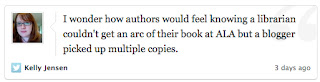
The single tweet that launched a post:

The ARC stops here
“I do not for a second believe that ALA should be entirely closed off from those who aren’t librarians. I think it’s an incredible convention for those who love books and reading and knowledge and literacy and technology and the many other facets of librarianship interest that exist. It’s valuable for so many people, including teachers and bloggers and those who are simply readers.”

So to that end, I hope the story makes a heck of a lot more sense now. I have been overwhelmed with response, and I just can’t respond any further than suggesting that the responses already exist here. The belief this isn’t a legitimate concern has me mulling over even more bloggable topics, including belittling professional interests and speaking as an expert on a topic when you have no clue what the topic being discussed even is.

I have avoided reading posts and comments, but I want to do something in this space. I want to say my post was never meant to be an attack on the girls who made the video, and I’m repulsed by anyone who did that. It was meant as an example of the behavior that’s been going on for a long time. I am impressed by their response.

Like I said, people learn and grow. And within days? Those girls got it. I’m impressed as hell.

Will I say more on this? Maybe. But what I want clear is that this time, I was heard. In two days, there were over 10,000 hits on the blog. Thousands of Twitter replies. I hit a nerve that went well beyond my control — but you know, there it is.


Filed Under: big issues, collection development, In The Library, Professional Development, readers advisory, Uncategorized

  • « Previous Page
  • 1
  • …
  • 3
  • 4
  • 5
  • 6
  • Next Page »
  • Facebook
  • Instagram
  • Pinterest
  • Twitter

Search

Archives

We dig the CYBILS

STACKED has participated in the annual CYBILS awards since 2009. Click the image to learn more.

© Copyright 2015 STACKED · All Rights Reserved · Site Designed by Designer Blogs