• STACKED
  • About Us
  • Categories
    • Audiobooks
    • Book Lists
      • Debut YA Novels
      • Get Genrefied
      • On The Radar
    • Cover Designs
      • Cover Doubles
      • Cover Redesigns
      • Cover Trends
    • Feminism
      • Feminism For The Real World Anthology
      • Size Acceptance
    • In The Library
      • Challenges & Censorship
      • Collection Development
      • Discussion and Resource Guides
      • Readers Advisory
    • Professional Development
      • Book Awards
      • Conferences
    • The Publishing World
      • Data & Stats
    • Reading Life and Habits
    • Romance
    • Young Adult
  • Reviews + Features
    • About The Girls Series
    • Author Interviews
    • Contemporary YA Series
      • Contemporary Week 2012
      • Contemporary Week 2013
      • Contemporary Week 2014
    • Guest Posts
    • Link Round-Ups
      • Book Riot
    • Readers Advisory Week
    • Reviews
      • Adult
      • Audiobooks
      • Graphic Novels
      • Non-Fiction
      • Picture Books
      • YA Fiction
    • So You Want to Read YA Series
  • Review Policy

STACKED

books

  • STACKED
  • About Us
  • Categories
    • Audiobooks
    • Book Lists
      • Debut YA Novels
      • Get Genrefied
      • On The Radar
    • Cover Designs
      • Cover Doubles
      • Cover Redesigns
      • Cover Trends
    • Feminism
      • Feminism For The Real World Anthology
      • Size Acceptance
    • In The Library
      • Challenges & Censorship
      • Collection Development
      • Discussion and Resource Guides
      • Readers Advisory
    • Professional Development
      • Book Awards
      • Conferences
    • The Publishing World
      • Data & Stats
    • Reading Life and Habits
    • Romance
    • Young Adult
  • Reviews + Features
    • About The Girls Series
    • Author Interviews
    • Contemporary YA Series
      • Contemporary Week 2012
      • Contemporary Week 2013
      • Contemporary Week 2014
    • Guest Posts
    • Link Round-Ups
      • Book Riot
    • Readers Advisory Week
    • Reviews
      • Adult
      • Audiobooks
      • Graphic Novels
      • Non-Fiction
      • Picture Books
      • YA Fiction
    • So You Want to Read YA Series
  • Review Policy

Shelter by Harlan Coben

September 13, 2011 |

There are so many adult authors who have decided the YA market is where they should apply their less than considerable talents these days, most notably __________ (fill in the blank with the author of your choice). It’s gotten a little tiresome. We know that writing for children and teens is not the same as writing for adults, and it’s frustrating when adult authors don’t know this and then fail miserably (or even fail in just a mediocre way).

Harlan Coben is not one of these authors. In Shelter, he’s created the sort of YA mystery I love: a fast-paced story with plenty of twists and turns and lots to think about. It’s a thrilling story, but it’s not a straight-up thriller. Too often I find that books described as thrillers don’t have much of a mystery to them – they’re all action – but that’s not the case with Shelter.

Mickey Bolitar’s dad has just died and his mom is in rehab for drug addiction, so he’s come to live with his uncle Myron, whom he’s not particularly fond of. (Myron Bolitar stars in his own series of books for adults.) The move necessitates a switch in high schools, something Mickey dreads, but he’s able to quickly carve out his own group of people: best friend Ema, quirky to the point of embarrassment Spoon, and pretty girlfriend Ashley.

Then Ashley goes missing. Of course, he sets out to find her, and it takes him places he never would have expected (including a strip club). The plot is twisty and surprising, but Coben doesn’t throw in anything that is completely out of left field. I wasn’t able to guess what was coming, but when it did, I believed it. That’s the hallmark of a good mystery.

Giving away any more of the plot would ruin the story a bit, so I won’t say any more, but what I can say is that Coben is clearly a pro at what he does. He is able to juggle so many different elements without dropping a single one, and it’s impressive.

Along with the complex mystery, he gives us a little insight into the relationship between Mickey and Myron, develops some intriguing characters in Ema and Spoon, and tackles the heartbreaking effects of drug addiction in Mickey’s mother. In other words, it’s a fully developed story that doesn’t write down to its audience or attempt to make its youthful characters into something other than youths. __________ (The author you used to fill in the blank above) should take a page from Coben’s book.

Of course, Shelter isn’t perfect. Some of the aspects of “teen culture” that Coben created seemed a bit too cliche. Ema and Spoon are fun to read about, but sometimes Spoon’s quirks strain credulity. It also strains credulity that Mickey, who is a self-deprecating but obviously pretty outgoing and good-looking guy, would choose Ema and Spoon – two of the school’s biggest outcasts – for his companions.

Those minor reservations aside, Shelter is a terrifically fun, edge-of-your-seat read. I read it in a single day and hardly even noticed the time pass. I hope Coben writes more about Mickey. The YA field could use more well-written mysteries that provide more than just thrills. I can’t really think of another author who currently provides this level of quality in their mysteries for teens. (I was a Joan Lowery Nixon addict as a teenager and those were some awesome mysteries, but seriously dated now.) Coben knows how to do it right.

Review copy provided by the publisher. Shelter is available now.

Filed Under: Mystery, Reviews, Uncategorized, Young Adult

In Trouble by Ellen Levine

September 12, 2011 |

Jamie and Elaine are best friends, but they don’t live near each other anymore. Most of their communication is via letter or periodic phone call; it’s through this that Jamie learns her best friend believes her boyfriend truly loves her. Elaine and he are ready for the next step. Jamie’s skeptical, especially given that this is the time when girls who found themselves pregnant were not only looked upon as problems, but they were often sent away to temporary homes until they were forced to give up their babies and then returned home. Everyone knew who was “in trouble” during these times. When Elaine finds herself in trouble, as much as Jamie’s reluctant to help, she does what she can through her family connections to try to solve the problem.

Here’s the ringer, though: Jamie is also in trouble. But Jamie finds herself that way not because she’s in love with a boy, but because of something out of her control. Suddenly, she feels like she has no where to turn, and she’s definitely not ready to have a baby — nor is she ready to be sent away.

In Trouble had immense potential, but for me, this book fell flat. The setting, during the late 1950s/early 1960s amid the scandals of McCarthyism, was full of fodder — this was a time in history when so much political turmoil spilled right into social issues, and it was a time prior to the women’s liberation movement. Levine sets her story in a great time to tackle the issue of teen pregnancy. The problem is, though, that it’s never once believable. Perhaps the bigger issue is that this book felt like a teen problem novel of the 1950s and never once like a work of historical fiction that investigated the sharp dynamics of the time period.

Jamie and Elaine are flat characters in the story. I didn’t find myself buying their friendship, especially given that Elaine didn’t seem interested in having a strong relationship with Jamie. She just needed an out. For me, it felt like the dynamics of their friendship existed only as a means to push the plot forward. More than that, though, I found that Elaine’s situation served merely as a way for Jamie’s story to emerge. Jamie’s scared and confused when she learns of Elaine’s pregnancy, though she’s not entirely surprised, given that she knew Elaine and her boyfriend were having sex. She wants to help her, and she does. This in and of itself is not the problem; instead, the problem emerges when suddenly, we’re tossed into a foreign situation to both us and to Jamie, where she’s taken advantage of and finds herself pregnant. I found this scene entirely jarring and out of character with anything Jamie would do (and no, I’m not blaming the victim here). Part of this is because I don’t ever truly get to know Jamie. I only get to know her through her relationship with and beliefs about Elaine, and thus, when she finds herself in trouble, I have a hard time believing it. Elaine’s pregnancy seemed like a convenient manner in which to insert Jamie’s pregnancy and thus, a subplot on the issues surrounding pregnancy via rape.

The book lacked true character development, as both girls were made into who they were simply through what happened to them. This is where I felt the book fell into being a traditional problem novel rather than a work of historical fiction; had the characters been pushed further, more strongly fleshed, then I think the storyline could have really blossomed. I’d have really liked a stronger development, too, of the time period. Though we get it, given that we know what happens to girls who become pregnant and through the fact that Jamie’s father finds himself in trouble because of his association to McCarthy, I feel like a stronger flair to the time period could have also made the story fuller. I say this as an adult reader, but I think that many teen readers who pick this one up just won’t see the heft here because of the weak characters and the weak setting. There are so many books tackling teen pregnancy that given more depth to their stories, and a novel that approaches the topic and does so in a historical context needs to offer more of both to have it carry the weight it should for readers. The writing is just not there.

The biggest issue I had with the book, though, comes with a bit of a spoiler warning. During this era, girls didn’t quite have the freedom that Jamie and Elaine seem to have. By that I mean there is no way that abortion would have been such an easy choice as it is in the story. Moreover, it wasn’t as acceptable as the novel portrays it to be. I think had the writing been stronger and the characters more developed, perhaps this aspect of the plot wouldn’t have bothered me as much, but unfortunately, the weakness in writing spills into the weakness of the handling of big ethical dilemmas here, too. This is a short book — just over 200 pages — but I feel like 400 pages worth of material are covered. I struggled to get through them. Had it been written more strongly, had the story not felt like a problem novel, and had I found the characters in any way interesting, I could have devoted more time and interest in a longer book.

In Trouble will appeal to your readers who like stories set in the past, as well as those who are interested in this historical period. I handed it over to a teen who loves stories of teen pregnancy, as well. The challenge, though, is I think many will walk away disappointed because the story just isn’t quite there. It feels more preachy than absorbing and lacks a lot of the elements that take a good idea from simply an idea to a true story.

Review copy received from the published. In Trouble is available now.

Filed Under: Reviews, Uncategorized, Young Adult

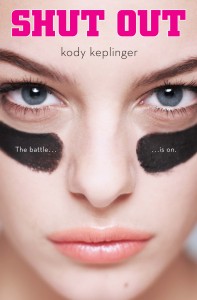
Shut Out by Kody Keplinger

September 9, 2011 |

Lissa’s tired of the rivalry. She’s tired of the pranks. And she’s tired of being interrupted when she and boyfriend Randy are having fun in the back of his car. At Hamilton High, there’s been a ten year rivalry between the football team and the soccer team. No one’s quite clear why the fight began, but Lissa’s determined to make it end. She wants her boyfriend back, and she wants to quit having to feel like she’s been an accomplice to the acts he and his team members commit against the soccer team. Lissa knows just how to make it happen: a freeze out.

Lissa and fellow girlfriends of the teams gather together and develop a plan wherein none of them will allow their boyfriends the opportunity for making out or for sex. By denying the boys of their pleasure, the girls reason that they will be driven by their primal urges to quit the rivalry and instead focus on what really matters to them.

If this sounds at all familiar, that’s because Keplinger’s sophomore novel is thinly based on the Aristophanes play Lysistrata. Despite that, readers who are unfamiliar with that particular play will still understand the plotline, as it’s one that’s played out time and time again in films and other books. It’s a classic battle of the sexes, but what Keplinger does in her take on the story is amped it up into an all out story about sex and sexuality.

Where Keplinger was brutally honest in her portrayal of teen sex and romance in The DUFF, I felt like it was overdone in Shut Out. The sex here is amped up, and it’s the spotlight of the entire story. Lissa, despite being a well-developed character through her desire to be a strong and independent female, has her personality overshadowed by sex. We meet her in the midst of almost having sex with Randy. Then we see her gain her power through withholding sex. Then we see that really, the entire thread about sex was perhaps a bit of a charade in the greater context of the story. I can’t say much more without ruining the plot, but in short, I felt like we lose out on getting to know Lissa’s character because of how rampant sex is in her storyline.

I made it pretty clear that sex is the theme of the book, and while I felt like it’s fairly authentic to teens, there were times it felt like it went more into the realm of feeling like a book set on a college campus than a book set on a high school campus. By that, I mean that the discussions of sex were much more frank and open than I can believe high schoolers having; it felt too mature and experienced, which still seems like a strange way to differentiate sex between high school and college. Although sex happens in high school, what this book seems to do is make it seem like everyone is participating in it. Anyone who isn’t is somehow branded as weird and those virgins are made to look like they’re criminal. Like it’s something to hide and be shameful of. I’m not sure if that message is ever quite resolved at the end, but it’s one that rubbed me the wrong way a bit.

Moreover, I really didn’t like the mixed message that came with sexuality. Here, sex was power. Withholding it gave these girls a sense of empowerment and a reason to make their boyfriends change. What it boils down to for me is that these girls all equated sex with being feminist, and that’s something that leaves a bit of a sour taste in my mouth. Again, the real potential for the girls to be powerful and dynamic and make a statement about themselves and their feelings about this childish rivalry relies solely on sex, rather than on being clever and cunning with their minds.

While I am fine with sex in my teen books – because it IS a reality – I think this one pushed the limits a bit. Readers who were uncomfortable with The DUFF will certainly find this read more uncomfortable, so beware this one is frank and blunt.

Another challenge I had with this book is the plan that Lissa and her fellow athlete girlfriends have for getting their boys to stop the rivalry. Actually, it’s not the plan itself that was problematic, but it was the execution of the plan. Never did the girls consider how to unify against the boys or make the boys understand what was going on. They were all on their own. Again, because I don’t want to ruin the big reveal with Lissa, I can’t explore this further, but having a plan that required the girls to all be individual agents of a group change effort wasn’t really a smart idea. Moreover, giving the boys some sort of heads up would have potentially made it more effective. As much as it bothered me, I do have to say that it felt very authentically teen. The planning and ideas were there, but the lack of world experience didn’t give the teens the keen insight to seeing the greater picture of how things would or could really play out.

Despite the issues I had with the book, there is something to be said about Keplinger’s ability to write dialog and to write stories with teen appeal. I felt like the moments when characters interacted were honest, and the conversations they had felt like the kinds of things I hear when I’m around teenagers at work or in the high school. The kids aren’t set up to be brainiacs nor are they deeply philosophical. They’re real. The story is fast paced, and even though I felt the characterization drowned in the midst of sex, the characters ARE developed within the pacing. The threads aren’t too loose and the story doesn’t fall apart because of it. Keplinger’s writing reminds me a lot of Simone Elkeles, and I think that the topic at hand fits with that comparison, as well.

Shut Out is a book to hand off to your reluctant readers and those who like a story that’s edgy and sexually-charged. Though there will certainly be readers turned off by the topic at hand and the frankness with which it’s handled, there is a lot of appeal to Keplinger’s story. Fans of The DUFF will certainly want to read this, as will fans of Simone Elkeles. I think this book would make for a really interesting book club choice, too, as there are a lot of fleshy bits worth talking about – think feminism, sexuality, and even the idea of rivalry.

Review copy received from publisher at ALA. Shut Out is available now.

Filed Under: Reviews, Uncategorized, Young Adult

The Princess Curse by Merrie Haskell

September 8, 2011 |

Fairy tale re-tellings were popular when I was growing up and continue to be popular today – a testament to the enduring quality of the original stories. For me, the standard-bearer for these books has always been Ella Enchanted. It’s the best one I’ve ever read, and it continues to be terrific upon re-reads. This is also partially a bad thing, since nothing can measure up to it.

After droves of re-tellings of more popular stories (Cinderella is the perennial favorite), authors are digging deep to locate the tales that haven’t been so oft told. Shannon Hale did an admirable job with The Goose Girl in 2003, and she followed it up with Book of a Thousand Days (based on an even more obscure fairy tale) in 2007. East of the Sun, West of the Moon has also had its heyday, with Sarah Beth Durst, Edith Pattou, and Jessica Day George all trying their hand at it.

More recently, it seems that The Twelve Dancing Princesses has become the new “it” fairy tale. My first foray into The Twelve Dancing Princesses was Jessica Day George’s Princess of the Midnight Ball in 2009 – a story I enjoyed but didn’t connect with much. Then came Heather Dixon with her own take on the story in Entwined, another enjoyable and competently written tale that also didn’t truly speak to me.

Now Merrie Haskell has taken the story and made it her own, in perhaps the most unique way of the three writers. In The Princess Curse, thirteen year old Reveka is an apprentice to the local herbalist in an Eastern European-type kingdom. The prince has twelve daughters who wake up each morning tired, their shoes falling apart. It’s obvious they’ve been dancing somewhere, but they haven’t even left their room.

The prince has offered a sizeable reward to anyone who can figure out where the princesses go each night and break the curse that causes the dancing. Unfortunately, anyone who tries to spend the night in the same room as the princesses in order observe them falls asleep – and never wakes. This is where Reveka comes in. As the herbalist’s apprentice, she believes she can find some combination of herbs that will allow her to remain awake, follow the princesses, and break the curse.

Reveka is indeed able to follow the princesses one night – right into an underground kingdom ruled by a rather fearsome dragon-type creature called a zmeu. The zmeu, who goes by the name Lord Dragos, has put the curse on the princesses which causes them to dance every night. You know how it goes.

Or you think you do. One of the things that sets this re-telling apart from the others is that Lord Dragos is surprisingly sympathetic. He and Reveka develop a very slight Hades/Persephone relationship, although it’s not quite romantic and certainly very PG. The presence of Lord Dragos and his underground kingdom – which has other pretty spooky elements – gives the book a darker tone. Lord Dragos’ kingdom feels like the underworld in many ways.

Haskell throws in some other subplots so the reader’s attention is not focused entirely on the dancing princesses storyline. Reveka has a strained relationship with her father, and she doesn’t know what to make of a sort of stupid (she believes) boy who won’t leave her alone. Reveka is also trying to save the sleepers, who are dying off without ever waking. Reveka’s voice is a real highlight here. She’s funny, sometimes snarky, often wise but just as often naïve. She’s believable as a thirteen year old girl, although perhaps more capable in dealing with a zmeu than you would have expected.

This is Haskell’s first book, and it shows. There are some pretty major pacing problems – long sections where the book drags and nothing is really accomplished – and a silly loose end inserted abruptly at the end that irritated me intensely. Overall, though, this is a solid debut that should appeal to girls who enjoyed Ella Enchanted. (Though it’s certainly no Ella Enchanted.)

Unfortunately, like the other two re-tellings of this story I have read, I wasn’t able to really connect with The Princess Curse. While the book had weaknesses of its own unconnected with its status as a re-tooling of The Twelve Dancing Princesses, it’s also become apparent to me that this is just not my fairy tale. Dancing has never really held much appeal for me, and reading about dancing is a little boring. The stakes never seem especially high (You’ll ruin your shoes? Well isn’t that a terrible fate.), even though the authors imbue plenty of danger into the story. And I think I would enjoy the story a lot more if it were the Two Dancing Princesses, or maybe just The Dancing Princess. Twelve is simply too many.

So with that in mind, I can tentatively recommend this one for middle-grade readers who like their fairy tales with a darker twist. Me, though? I think I’ll stay away from this fairy tale from now on.

Review copy provided by the publisher. The Princess Curse is on shelves now.

Filed Under: Fantasy, Reviews, Uncategorized, Young Adult

Glow by Amy Kathleen Ryan

September 6, 2011 |

Sometime in the future, our earth has been made unlivable. A group of colonists set out on a course for New Earth, hoping to keep the human race alive. They journey in two ships: the New Horizon, which holds the religious colonists, and the Empyrean, which holds the non-religious colonists. (Full disclosure: I think the explanation for separating the people into these two groups is stupid and not believable. But it’s necessary for the plot. And the rest is so well done. I forgive the author.)

On the Empyrean we find teenagers Waverly and Kiernan, our two protagonists. Waverly is the first person born on the ship, and she’s been dating Kiernan, the son of the commander, for some time. The journey is going to take awhile, so it’s necessary for the people on the ship to reproduce. This means the youth on board are encouraged to marry early and reproduce often. Waverly and Kiernan become engaged near the beginning of the book, and all seems well.

Then the Empyrean meets up with the New Horizon, with which they have not had contact for a long time. Without warning, the New Horizon attacks the Empyrean, kidnapping all of the young girls – including Waverly – and taking them to the New Horizon. The Empyrean is left decimated, intact but not really able to function. Those left on board, including Kiernan and all of the other boys and adults, are pretty much left to die.

Why would the crew of the New Horizon do this? Glow explores this question in chapters that alternate between Waverly and Kiernan’s points of view. From the beginning, it’s obvious to Waverly and the other girls that the people on the New Horizon are bad – the girls have been kidnapped, their parents are dead, their brothers probably dead too. But things on the New Horizon (and by extension the Empyrean) are not what they seem, and it’s a testament to Ryan’s skill as a writer that she makes the reader question everything multiple times right along with Waverly. (Waverly, by the way, is an awesome character who shows tremendous growth throughout the novel. She’s a thinking woman’s badass.)

Meanwhile on the Empyrean, Kiernan, as the commander’s son and natural next in line, struggles to maintain control of the ship and plan a rescue amid technical malfunctions and the threat of mutiny from the other boys.

This book definitely needs open-minded, careful readers, those who aren’t quick to feel angry over what others may see as the author’s attempt to demonize believers or non-believers (and both sides can be argued). Religion is such a touchy topic, one that forms the core of so many people’s identities, and it can be tough to handle well. Ryan has certainly succeeded with Glow. She presents an even-handed account of people on both sides of the faith coin. The believers and the non-believers are equally sinister (despite what the initial attack may convey), and it kind of blows my mind that some reviewers are so caught up in whining that their religion is being demonized that they miss the fact that the non-believers are baddies too – and not a lesser kind of bad.

Ultimately, though, Glow is not a story about God’s existence – it’s a story about how people use the belief or lack of belief in God in order to wield power. It’s about how people can seize upon an incredibly powerful idea and use it as a tool to achieve their own goals. It’s a story about manipulation and control and human nature, all tied up with a fantastic science fiction story where nothing is what it seems.

Part of what makes Glow so effective is that Ryan thwarts reader’s expectations at every turn, primarily where characters’ actions and motivations are concerned. Just when I thought I had nailed down who was good and who was bad, who was our protagonist and who our antagonist, Ryan threw me for a loop and I had to completely reassess everything. And then she did it again. I think her point is that there isn’t really a “good” or “bad” side – it’s not that easy. I love when books can flip things multiple times and make it authentic, just part of the natural growth of the characters and development of the plot.

And of course, there’s a great story here – action, love, betrayal, the fate of the new world at stake. This type of science fiction is supposedly the next big thing in YA literature (the space travel kind of science fiction, not the dystopia kind of science fiction, which peaked awhile ago). I’m excited about that. I’ve always been a fan of the type of science fiction that involves exploring completely new worlds. There’s so much room for creativity and uniqueness there, and I could see a lot of great stuff coming out soon – provided the authors exploit that possibility for creativity and don’t forget that good stories need good characters. Otherwise, we’ll just be seeing a bunch of carbon copies with flat characters and predictable plots.

Glow is the first in a series, but it’s so well done that I didn’t mind. There’s at least a climax and a resolution, which so many first entries lack. And Ryan writes so well that I look forward to seeing what else she does.

Review copy provided by the publisher. Glow will hit shelves September 13.

Filed Under: Reviews, Science Fiction, Uncategorized, Young Adult

  • « Previous Page
  • 1
  • …
  • 92
  • 93
  • 94
  • 95
  • 96
  • …
  • 154
  • Next Page »
  • Facebook
  • Instagram
  • Pinterest
  • Twitter

Search

Archives

We dig the CYBILS

STACKED has participated in the annual CYBILS awards since 2009. Click the image to learn more.

© Copyright 2015 STACKED · All Rights Reserved · Site Designed by Designer Blogs