• STACKED
  • About Us
  • Categories
    • Audiobooks
    • Book Lists
      • Debut YA Novels
      • Get Genrefied
      • On The Radar
    • Cover Designs
      • Cover Doubles
      • Cover Redesigns
      • Cover Trends
    • Feminism
      • Feminism For The Real World Anthology
      • Size Acceptance
    • In The Library
      • Challenges & Censorship
      • Collection Development
      • Discussion and Resource Guides
      • Readers Advisory
    • Professional Development
      • Book Awards
      • Conferences
    • The Publishing World
      • Data & Stats
    • Reading Life and Habits
    • Romance
    • Young Adult
  • Reviews + Features
    • About The Girls Series
    • Author Interviews
    • Contemporary YA Series
      • Contemporary Week 2012
      • Contemporary Week 2013
      • Contemporary Week 2014
    • Guest Posts
    • Link Round-Ups
      • Book Riot
    • Readers Advisory Week
    • Reviews
      • Adult
      • Audiobooks
      • Graphic Novels
      • Non-Fiction
      • Picture Books
      • YA Fiction
    • So You Want to Read YA Series
  • Review Policy

STACKED

books

  • STACKED
  • About Us
  • Categories
    • Audiobooks
    • Book Lists
      • Debut YA Novels
      • Get Genrefied
      • On The Radar
    • Cover Designs
      • Cover Doubles
      • Cover Redesigns
      • Cover Trends
    • Feminism
      • Feminism For The Real World Anthology
      • Size Acceptance
    • In The Library
      • Challenges & Censorship
      • Collection Development
      • Discussion and Resource Guides
      • Readers Advisory
    • Professional Development
      • Book Awards
      • Conferences
    • The Publishing World
      • Data & Stats
    • Reading Life and Habits
    • Romance
    • Young Adult
  • Reviews + Features
    • About The Girls Series
    • Author Interviews
    • Contemporary YA Series
      • Contemporary Week 2012
      • Contemporary Week 2013
      • Contemporary Week 2014
    • Guest Posts
    • Link Round-Ups
      • Book Riot
    • Readers Advisory Week
    • Reviews
      • Adult
      • Audiobooks
      • Graphic Novels
      • Non-Fiction
      • Picture Books
      • YA Fiction
    • So You Want to Read YA Series
  • Review Policy

Cover Trend: The Almost-Kiss

February 29, 2012 |

So here’s a 2012 cover trend that can be shelved beside girls hanging out under water and getting up close and personal with shoes and that’s the almost-kiss. It’s by no means a new trend, but it’s one that the more I see it, the less I can distinguish the books from one another — and some are even the same teens in the picture. For me as an adult reader (and I know I’m not the target demographic), these covers aren’t the kind I like being seen in public with. In fact, I’ll take off the dust jacket for hardcover books that have the almost-kiss on the cover. But more frustrating, I think, is not all of these books are about the romance. Some are, but not all of them are, and I think in depicting the cover image as the almost-kiss, the book is being branded as only one thing. It’ll automatically turn off many readers — the Vivian cover I linked to above? My teens really don’t like it because it makes the book look like it’s a romance when in fact, it’s a story with a lot of great feminist messages in it.

Here’s a sample of this year’s almost-kiss covers. Are there others? What are your thoughts? All descriptions are from WorldCat.

 
When You Were Mine by Rebecca Serle (May 1, 2012): Seniors Rosaline Caplet and Rob Monteg, neighbors and best friends, have finally become a couple at their Southern California high school, but when Rosie’s estranged cousin Juliet moves back into town and pursues Rob in an unstable, needy, and vindictive manner, Rosie starts to worry not just about Rob’s emotions, but about his very life.
 
Something Like Normal by Trish Doller (June 19, 2012): When Travis returns home from Afghanistan, his parents are splitting up, his brother has stolen his girlfriend and car, and he has nightmares of his best friend getting killed but when he runs into Harper, a girl who has despised him since middle school, life actually starts looking up.
 
Try Not to Breathe by Jennifer R Hubbard (available now):  The summer Ryan is released from a mental hospital following his suicide attempt, he meets Nicki, who gets him to share his darkest secrets while hiding secrets of her own.
 
First Comes Love by Katie Kacvinsky (May 8, 2012): Ten months after his twin sister dies, with his family falling apart, Gray Thomas meets an unusual girl at the community college who makes him think life is interesting again.
 
The Thing About the Truth by Lauren Barnholdt (July 10, 2012): In this story told from alternating viewpoints, seventeen-year-old Kelsey seeks to redeem her formerly flawless reputation with the help of a senator’s sexy but arrogant son, who has ulterior motives.
I’m not entirely sure how fitting the covers are for the books, though some of them hint at the romance that’ll emerge in the story. It’s a bonus we get the windswept hair in one of them, too.

Filed Under: aesthetics, cover designs, Uncategorized

The Hardcover to Paperback Cover Switch: Six to Consider

February 15, 2012 |

I haven’t talked about book cover changes lately, and it’s something I’ve been doing a lot of thinking about lately. I’m working on a post about series books and mid-series book cover changes (specifically, about how much they impact libraries and librarians), but in the mean time, I thought looking through some recent cover swaps would be fun. It’s always interesting to see how a cover is revisioned when it moves from hardcover to paperback, as sometimes it’s spot on, and other times, it’s worse.

Here’s the hardcover of Franny Billingsley’s Chime, and it’s a cover I’ve never been a fan of. I haven’t read the book, but from everything I know about it, it just doesn’t seem like a good fit of a cover. It’s the girl, I think — she detracts from the fantasy aspect of the story for me. I don’t care a lot for the color scheme here either, as it’s dull and almost lifeless. It’s a sleepy cover.

Billingsley’s book comes out in paperback in April, and it’s getting a makeover. This works for me, and I think it’ll attract a new range of readers. Even though I’m not a huge fan of the face-on-the-cover, this girl is much less “dead girl” than the hardcover edition, and she’s even got a spark of power to her (I see it in her eyes and the fact her hair isn’t blown across her face). Moreover, I’m a fan of the change from a drab color scheme to a brighter one. The cover kind of reminds me of the repackaged Francesca Lia Block books. I find it interesting the paperback features a blurb from Libba Bray, whereas the hardcover edition didn’t have a blurb.

The hardcover edition of Cathy Ostlere’s Karma is interesting to me because it’s so simple. I read this book last year, and it’s a lengthy verse novel about 1980s India and the search for heritage. It’s a hard sell conceptually for teen readers but I think the cover here does the story some favors in that it might entice otherwise skeptical readers. It’s pink with yellow designs that are an homage to Indian culture. The couple on the front (beneath the title and above the author’s name) make sense in context of the story, too. I love the title font and how it fits nicely with the font for the author’s name, too. Sometimes the simpler, the better.

The paperback of Ostlere’s book came out in January, and you know, I think they got it even more right in this cover. Even though both the paperback and cover fail to give the sense of time period (I’m not sure how they could), I feel like both do a good job giving a sense of place. Like the hardcover, the paperback features a great title font, though I do find the font selected for the author’s name to be a little distracting. It’s not as in sync with the title font as the different fonts on the hardcover edition are. I love, too, that the cover doesn’t appear to be whitewashed; while we don’t get to see a face, the hands and arms here are brown and not white. For me, the flowers she’s holding sort of represent the heritage aspect of the story. Although they’re wilting, the girl’s holding them with reverence and respect. More generally, I find the color palette works here, and it’s all together visually appealing. There is just enough going on to keep an eye engaged without being over-the-top.

Adele Griffin’s psychological thriller Tighter is another cover that had a dull color palette going for it, but because of the story, I think it works just fine. I like the shadowy figure against the cover, almost like there’s a film over the picture and the person is trying to see through. It’s fitting for the story and I think it helps give the book a genre classification. It’s reminiscent of a scary film. The title font works fine, as does Griffin’s name font. I do find it interesting her name is larger than the title itself.

The paperback edition of Tighter will come out in June, and I think it hits the mark pretty well, too. It’s got the sort of drab but haunting feel of the setting with the darker background color, and the girl who is ghostly captures the genre of the story. I note again the fact that the author’s name is larger than the title, which I think is an interesting choice. I like that the fonts are the same (or at least very close to the same) as those on the hardcover. They work well, and the slight blur to the title font isn’t dizzying nor distracting. My one comment on this one is I think the cover might be more appealing to female readers than the hardcover, simply because it’s more obvious it’s a girl at the center of the story.

I think that the cover of Julie Chibbaro’s Deadly is jarring because it’s an uncomfortable color of greenish yellow, but it’s a cover that stands out for me because of that (as well as the silhouette-style girl on the cover, her dress crawling with infestation). This book stands out on a shelf, and I think it does a good job reflecting the content inside. It’s a story based on the legend of typhoid Mary, and it’s heavily vested in the science of disease. I’m a fan of the red font and lower case only lettering on the title, and I like that the tag line shifts its color scheme when it’s laid over the girl. One of the themes of this story is the role of females in society and the book challenges what it was to be a female in the early 20th century, especially when it comes to being a female interested in science. I think the cover does an interesting job reflecting that in portraying a girl in a big dress and in the fact the girl’s at a full stance. Her head is up and the bugs are moving down and away. She’s got some power and defiance to her.

The paperback edition of Deadly will be out at the end of the month, and I’m not feeling it the way I felt the hardcover. It’s dark and shadowy, and I don’t think it at all gives a sense of time — though admittedly, it probably gives a decent sense of place, as the story’s set in early 1900 New York City. There’s a definite mood developed in the image, but I’m not entirely sure it fits the story itself. The girl in the dress is in the shadow on the ground and at full stance, but I don’t think it connotes quite the power the girl in the hardcover edition does. I’m not a fan of the title font here, as I think it kind of bleeds right into the image itself. For me, this book looks a lot more like a mystery than a historical fiction, and I’m afraid it’ll blend into other books that just look dark on the shelf.

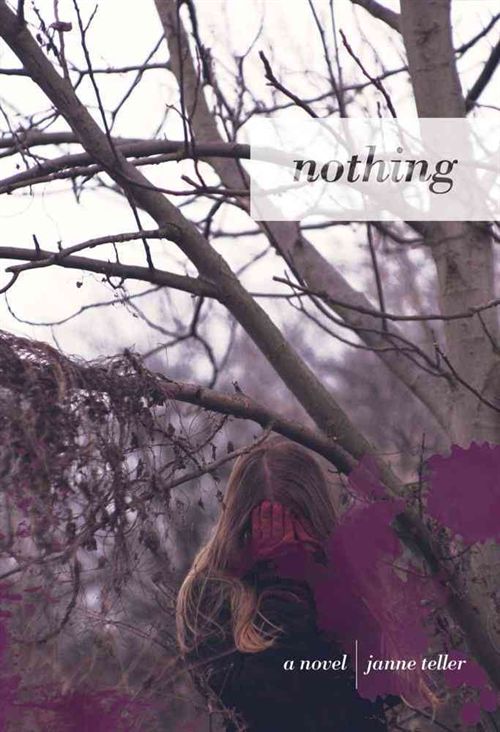
I can’t remember if I’ve talked about not being a fan of Janne Teller’s utterly bleak novel Nothing — but see, the thing is, I wasn’t a fan and yet it’s a book I think about a lot and think deep down I kind of admired for being so risky and different. The hardcover of the book is spot on in depicting the feeling of hopelessness the book conveys. It’s a late fall or early winter setting, with the trees lacking their leaves (need I tell you the symbolism there?). I quite like how the title is in a light box on top of the trees but the title itself almost fades into the background as if it, too, were nothing. I think the single girl in the middle crying into the one spot of color in the cover captures the story so, so well. I’m a little torn on teen appeal of the cover since it is so heavily symbolic and it’s not necessarily a stand-out on the shelf; however, the teens that this book would appeal to will so get the cover and appreciate it. It may be what draws them to it in the first place.

The paperback of Teller’s novel will be out in March, and it, too, gives a nice sense of the bleakness in the story. But this time, we have two people embracing one another, almost in desperation. I don’t read this as romantic at all and I think that it captures the mood of the book well. It’s desperate (at least for most of the characters). The coloring of the cover is again dulled, though this time, there’s not a symbolic spot of color quite the way there was in the hardcover, unless you count the girl’s hair. The title being centered and spread widely across the center of the image works, too, and like the hardcover, I think the simplicity of it helps it sort of blend in all together. 

I have a pile more of cover changes I want to talk about, but I’ll save them for another post in the near future — except one. Most of the changes above haven’t elicited a whole lot of reaction from me. I don’t think any of them are way off base, even though I’ve certainly preferred some of the hardcovers over the paperback. But here’s one I really don’t like. One that I think is a mega disservice.

Gabrielle Zevin’s All These Things I’ve Done has a great hardcover image. I love that the title is in red on graying image, and the only other spot of color is the dripping chocolate heart. There’s the back image of the cityscape, and while it’s shadowy, there’s enough recognition to know it’s New York City (even if in the story it’s a distant, future NYC — the shadow effect here gives a bit of the potential for the physical appearance to be different at that time). Aside from the heart, I think this is a cover with appeal to both genders because it’s fairly ambiguous. I appreciate there’s not a face or a person on the cover, and really, there is something to be said for simplicity in cover design. The other thing I think is neat about this cover is the juxtaposition of the all lower case lettering of the title with the all upper case lettering of the author’s name at the top, and yet, neither competes to be the bigger role. They’re in harmony.

Enter the paperback edition of the Zevin title and while we still have quite a bit of a blurred city image that works well, we now have a girl face. A girl face that looks a bit vamp-ish and scary. For me, this book is much less about the dystopic future of a city without chocolate or coffee but about a girl who looks like she’s going to do some pretty bad things in the city. I can’t put my finger on exactly what movie or television show image it reminds me of, but it reads much more action-adventure to me than the story really is. Although the new color palette doesn’t bother me, it’s the way the girl still manages to jump out from it that doesn’t work for me. There may also be a little too much going on in terms of the fonts, the stacking, and the color use in the title and author text.

Now I’m curious — do you think any of these do it better in one edition or the other? I’ve heard more than once that the hardcover is the one aimed toward librarians while the paperback is the one aimed at the true teen demographic, though I’m not sure how much I buy that excuse at all if the true goal is to sell a book (there’d be as much emphasis on both then to produce the best possible cover, period). Or have you seen any changes recently — say the last six months or so — that have caused you to stop and wonder why the change was made?

Filed Under: aesthetics, cover designs, Cover Redesigns, Uncategorized

Double Take (Actually a Triple-Take)

January 27, 2012 |

While looking up the US cover for 172 Hours on the Moon for my Midwinter post earlier this week, I came across the UK cover and immediately knew I had seen it before.

If you’re a long-time reader of STACKED (and I hope you are!), you’ve seen it before too…not once, but twice.

After the Moment by Garret Freymann-Weyr and The Sky Isn’t Visible From Here by Felicia C. Sullivan, which Kelly wrote about back in 2009.

That’s certainly a popular image.

Filed Under: cover designs, Cover Doubles, Uncategorized

Double-Take (Mostly)

January 19, 2012 |

You guys, this whole not being able to talk about the books I’m reading thing (due to the Cybils) is killing me. And actually, I’ve gotten to the point where I’ve reviewed every recent read that is a non-Cybils book (a first). But while I was in the book store the other day, I did notice another title that bore enough similarities to a Cybils read that it made me a do a double-take.


Archon: The Books of Raziel by Sabrina Benoulis is a fairly new release. It’s an adult supernatural debut about angels and witches and a young woman caught up in a prophecy. Based on reviews, it seems to have some crossover YA appeal, but I haven’t read it so can’t tell you for sure. The main reason my eye was drawn to it is because it reminded me very strongly of…
…Anna Dressed in Blood by Kendare Blake, Cybils nominee. The covers aren’t exactly the same, but they’re similar: a girl viewed from the back, her hair strangely floating off to one side, standing in front of an ominous-looking building. The two don’t seem to have a whole lot in common other than the fact that they’re both SFF. I do think the cover for Anna Dressed in Blood is a good match for its contents.

Filed Under: cover designs, Uncategorized

A Literary Mixtape

January 18, 2012 |

I’ve seen a cover trend over the last few years I really like. These books would look really neat together on a display, especially with appropriate props, when they’re all available. They’re a mix of adult and young adult, but they have one thing in common: cassette tapes. They’re visually appealing, and the way the tapes themselves have been incorporated into the cover varies enough they don’t at all look like double takes. I also appreciate none of these books are historical novels. At least for me, there’s not really a feeling of nostalgia in the covers, either.

When I was compiling these, I thought there might be a couple more out there. If you can think of what those might be, drop a comment and I’ll add them. All descriptions come from WorldCat.


Supergirl Mixtapes by Meagan Brothers (April 24, 2012): Sixteen-year-old Maria leaves her father and grandmother in Red Hill, South Carolina, to live with her mother, an artist who lives with her young boyfriend in a tiny apartment in Manhattan’s Lower East Side.


Greyhound by Steffan Piper: When Sebastien Rane’s mother can’t be bothered to take care of him, she sends him to his grandmother’s across the country on a Greyhound bus. I’ve read and reviewed this one.


Love is a Mix Tape by Rob Sheffield: A memoir, in which, Rob Sheffield, a veteran rock and pop culture critic and staff writer for “Rolling Stone” magazine, tells the story of his musical coming of age, and how rock music, the first love of his life, led him to his second, a girl named Renee.


Talking to Girls about Duran Duran by Rob Sheffield: Sheffield gets two books on this list. When he turned 13 in 1980, Sheffield had a lot to learn about women, love, music and himself, and here he offers a glimpse into his transformation from pasty, geeky “hermit boy” into a young man with his first girlfriend, his first apartment, and a sense of the world. It’s all here: Inept flirtations. Dumb crushes. Deplorable fashion choices. Members Only jackets. Girls, every last one of whom seems to be madly in love with the bassist of Duran Duran. Sheffield’s coming-of-age story has a playlist that any child of the eighties or anyone who just loves music will sing along with. These songs–and Sheffield’s writing–will remind readers of that first kiss, that first car, and the moments that shaped their lives.

Maybe that one is a bit more nostalgic than the others in terms of content, but I don’t get it from the cover.


Way to Go by Tom Ryan (Spring 2012, Orca books): I couldn’t find this one up at WorldCat yet, so I’ll just go ahead and direct you to Tom’s website for the lengthier description. I think of all the cassette tape covers, this one is my favorite. I love the lime green and how vibrant a feel it has. This one stands out on a shelf without a problem. (After I posted this, Tom got in touch with me to say the cover changed a little bit — you can check out the amended cover here. Same cassette tape, different title font).

Even though these aren’t all YA or all adult covers, these are books that’ll work with either audience, particularly because of the music tie-ins. It’s interesting, too, they’re all illustrations, rather than stock images (though arguably the Brothers title isn’t, but the writing on it sure is).

Can you think of any others to add with a cassette tape on the cover?

Filed Under: aesthetics, cover designs, Uncategorized

  • « Previous Page
  • 1
  • …
  • 16
  • 17
  • 18
  • 19
  • 20
  • …
  • 38
  • Next Page »
  • Facebook
  • Instagram
  • Pinterest
  • Twitter

Search

Archives

We dig the CYBILS

STACKED has participated in the annual CYBILS awards since 2009. Click the image to learn more.

© Copyright 2015 STACKED · All Rights Reserved · Site Designed by Designer Blogs