• STACKED
  • About Us
  • Categories
    • Audiobooks
    • Book Lists
      • Debut YA Novels
      • Get Genrefied
      • On The Radar
    • Cover Designs
      • Cover Doubles
      • Cover Redesigns
      • Cover Trends
    • Feminism
      • Feminism For The Real World Anthology
      • Size Acceptance
    • In The Library
      • Challenges & Censorship
      • Collection Development
      • Discussion and Resource Guides
      • Readers Advisory
    • Professional Development
      • Book Awards
      • Conferences
    • The Publishing World
      • Data & Stats
    • Reading Life and Habits
    • Romance
    • Young Adult
  • Reviews + Features
    • About The Girls Series
    • Author Interviews
    • Contemporary YA Series
      • Contemporary Week 2012
      • Contemporary Week 2013
      • Contemporary Week 2014
    • Guest Posts
    • Link Round-Ups
      • Book Riot
    • Readers Advisory Week
    • Reviews
      • Adult
      • Audiobooks
      • Graphic Novels
      • Non-Fiction
      • Picture Books
      • YA Fiction
    • So You Want to Read YA Series
  • Review Policy

STACKED

books

  • STACKED
  • About Us
  • Categories
    • Audiobooks
    • Book Lists
      • Debut YA Novels
      • Get Genrefied
      • On The Radar
    • Cover Designs
      • Cover Doubles
      • Cover Redesigns
      • Cover Trends
    • Feminism
      • Feminism For The Real World Anthology
      • Size Acceptance
    • In The Library
      • Challenges & Censorship
      • Collection Development
      • Discussion and Resource Guides
      • Readers Advisory
    • Professional Development
      • Book Awards
      • Conferences
    • The Publishing World
      • Data & Stats
    • Reading Life and Habits
    • Romance
    • Young Adult
  • Reviews + Features
    • About The Girls Series
    • Author Interviews
    • Contemporary YA Series
      • Contemporary Week 2012
      • Contemporary Week 2013
      • Contemporary Week 2014
    • Guest Posts
    • Link Round-Ups
      • Book Riot
    • Readers Advisory Week
    • Reviews
      • Adult
      • Audiobooks
      • Graphic Novels
      • Non-Fiction
      • Picture Books
      • YA Fiction
    • So You Want to Read YA Series
  • Review Policy

The 100 by Kass Morgan

November 27, 2013 |

This book has gotten a bad rap on Goodreads, and I don’t think it’s deserved. The premise is killer. The writing is competent and flows nicely. The plot is fast and the characters are full of secrets. I really liked it – it’s sci fi candy and I gobbled it right up.

The 100 refers to a group of people – juvenile delinquents who have been sent to re-colonize an irradiated Earth. Humanity has been living on space stations for generations, ever since the Earth became uninhabitable. But their resources are dwindling, and the adult scientists need to know if Earth is truly ready for habitation again. The teens will be the test subjects.

“Juvenile delinquent” in this future world is a fuzzy term. Crime is punished very severely, and almost anything is a crime. Adults who commit crimes are usually executed immediately. Minors are kept in “Confinement” until they turn 18, and are then given a retrial. Except the retrials are mostly shams and the teens are usually then executed as well. So for the teens who know what’s likely coming, they look at the trip to Earth as a reprieve from death.

We get the story from four different third-person perspectives – two girls, two boys. They range in age from 17 to 20 (or thereabouts). They’re Confined and/or sent to Earth for various reasons, though one of our POVs actually stays behind on one of the space stations, giving us more insight into that environment and the Earth experiment from the adults’ perspective. Each of the characters has a secret (some have more than one); some secrets are easier to guess than others. The secrets are revealed in flashbacks, which I normally loathe, but they work well here – they’re short and full of action, just like the present-day sections.

What irritates a lot of the reviewers is something that happens very near the end. We realize something one of the main characters did, and it’s monumentally stupid. Not just “I can’t believe I did that, that was so stupid” stupid. I mean that it really strains credulity. Breaks it, even. It certainly broke a lot of other readers. It didn’t ruin it for me, though. I gave it a bit of a side-eye, sure. But I figured I was so far down the rabbit hole of believability, this one further step wasn’t going to ruin my enjoyment. And it’s followed very closely by another revelation that I found quite believable and sets the book up nicely for a sequel, which I will certainly be reading.

So, world-building. There’s not much of it. If you want a lot of world-building that’s creative and makes sense and actually uses science that maybe, possibly could exist in the future, look elsewhere. This is not your book. If you have a very, very healthy ability to suspend your disbelief and prefer to digest your sci-fi at a breakneck pace, you might consider giving this a shot.

This is an Alloy (book packager) title, and it feels like it. It bears a lot in common with a few other packaged titles I’ve read – short chapters, multiple characters (often multiple POVs), lots of secrets that are teased out over time, an emphasis on plot, a concept that can be described in a snappy sentence or two. What surprised me is that the author essentially acknowledges that it’s a packaged title in the Acknowledgments (see what I did there?), at least in the arc version. She credits the idea for the story to someone else in the first sentence, and thanks several people, mentioning Alloy specifically, later on. As someone who looks for these sorts of things, this obviously caught my eye. I wonder how many teens 1. read the Acknowledgments, and 2. would care one way or another.

The CW has picked up this as a midseason premiere and I’m excited to have a look. I hope it’s as fun as the book.

Review copy picked up at Kidlitcon.

Filed Under: Reviews, Science Fiction, Uncategorized, Young Adult

Ink Is Thicker Than Water by Amy Spalding

November 26, 2013 |

Kellie Brooks thinks she knows herself, thinks she knows her best friends, and thinks she knows her family. But everything she thinks she knows begins to fall apart when her adopted sister Sara turns 18 and has the chance to meet her birth mother. And everything changes again when Kellie joins the school newspaper and realizes Adalaide, the girl she’d always thought was a dork, is actually not that dorky after all. And it changes further when her best friend Kaitlyn begins to drift away.

And Oliver, the brother of her sister’s boyfriend Dexter, only complicates Kellie’s life even further. After their awkward encounter last May, wherein he tried to get Kellie to have sex and she backed out, she thought his presence in her life was gone forever. But now it seems like he’s interested again.

Amy Spalding’s Ink Is Thicker Than Water is an excellent example of a true YA novel. It’s coming-of-age, but it’s coming-of-age through a perspective that’s quite minute and not world-shattering. What Kellie is going through and experiencing is entirely within the contours of her own life and her own experiences. She’s navigating a tricky situation in her family life, a change in what she thought were forever friendships, and an opportunity to pursue a romance with a boy who she thought would never again be a part of her life. Despite the fact none of the things that happen impact the greater world, they each play a huge part in impacting Kellie’s own world. And each of the things she encounters leads to her coming to better understand her role in her own life and in the lives of those around her — as well as her role in the greater world.

Family is the biggest aspect of this story, and Spalding isn’t afraid to look at a very complicated family dynamic that isn’t interesting because of its complexity and challenges, but rather, is interesting because it does work. Sara is Kellie’s older sister, but she’s adopted. Kellie’s mother and father were told the chances of them ever conceiving a child naturally were slim to none, and they chose to adopt Sara to start their family. It was no time before they conceived Kellie without a problem — though in no way are Sara and Kellie at odds with their places within the family. In fact, they’re as close as two sisters can be.

But the family gets more challenging, as Kellie and Sara’s parents are also divorced. Mom has remarried, and after a significant life reevaluation in the past, she also left her job as a paralegal and started working at The Family Ink — a tattoo shop — with her new husband. Mom and her new husband have a child together, a boy named Finn, who both girls adore and take turns taking care of. Kellie and Sara’s dad lives nearby, and though he doesn’t admit to being in a relationship with anyone else, he does have a girlfriend. Both girls spend time with dad, even though they live with mom. Despite being divorced, mom and dad get along, and both have their girls best interests at heart. So when Sara chooses to meet her biological mother, it’s not a surprise that both mom and dad support her decision to get to know her better, even if it does hurt them. But, of course, it’s a hurt that’s less about feeling abandoned and more a hurt of knowing their daughter’s growing up and learning how to make life choices and relationships for herself and her best interests.

Which is where this story really veers into something memorable. For Kellie, Sara’s decision to spend more time with her biological mother feels at times like a personal insult. Kellie’s not selfish, but she IS a teenager: Sara’s lack of time being spent with her feels like it’s done with the intent to make Kellie jealous and hurt, even though it has absolutely nothing to do with Kellie. It has to do entirely with Sara coming to learn how to be herself. This is something that Kellie eventually will figure out, as she, too, learns how to navigate these family relationships and the shifting that they can go through.

Kellie’s friendship and subsequent change in connection with Kaitlyn is really believable and it’s really honest. As Kellie begins to spend more time with the newspaper and honing her skills as a humor columnist (and yes, some of those columns are in the book to read), she’s spending more time with those who share those interests with her. Kaitlyn is doing precisely the same thing, though her interests aren’t in the newspaper or in writing. As a result, the girls begin drifting apart, even though it’s not in a nasty or mean way. Kellie takes it as an affront, though, as Kaitlyn spends more time with her new friends, and as readers, we see the loneliness this leaves her. She doesn’t want to hate Kaitlyn and she doesn’t want to be mad at her, but she can’t help feeling sad and lost as both Kaitlyn and herself throw themselves into new experiences and one of the consequences is their friendship changes. It doesn’t end. It just changes.

Change, if it hasn’t been obvious, is a key theme in Ink Is Thicker Than Water, and it might be argued that it’s through her relationship with Oliver that Kellie figures out change doesn’t need to be scary. Back in May, Oliver and Kellie were having a good time together and almost had sex — but she didn’t want it to happen and it didn’t. She wasn’t ready. Since then, Kellie worried that she and Oliver never had another shot, so when he pursued her again, she didn’t believe it. She didn’t believe someone could want to get to know her after she’d let them down before. But the truth was, Oliver appreciated that aspect of her.

From the outside, their relationship look great: Oliver loves to be in touch with Kellie, he wants to make things “Facebook official” quickly, and he’s always willing to be around for her, even if sex is something she’s not ready to enter the equation (and he’s incredibly respectful of this). The thing is, Oliver is a little bit . . . clingy. Desperate, even. And as much as Kellie loves the attention and loves the ability to reach him any time she wants to and needs to, she’s also a little wary of how much he wants to ensure their solidarity as a couple. Of course, there’s a reason for his actions, and Kellie will discover what it is when she’s out with his brother Dexter. But more than discover what it is causing Oliver to act as he does with her, Kellie will realize that she’s not too different from him, but in her relationship with her sister. It’s this ah ha moment when Kellie not only appreciates Oliver even more, but it’s in this moment when Kellie comes to understand that people can and do change and that change doesn’t have to be scary.

Change can be a good thing.

One of the most enjoyable parts of this story for me has to do with Kellie’s relationship with sex and virginity. As noted, she almost had sex with Oliver upon meeting him for the first time months ago, but she backed out, saying she wasn’t ready for it. So when he returns to her later, she’s worried that that choice will forever be the reason he would not be the reason he’d want to be in a relationship with her. If she hurt him once, the potential to do it again and again exists. But Oliver doesn’t believe that. When their relationship develops, sex remains in the back of Kellie’s mind regularly: she’s not ready for it. But rather than keep that voice at bay, she’s open and honest about it with not just herself, but with Oliver as well. At times it comes out awkwardly, but it’s that awkwardness that’s honest and real. It’s a tricky topic, and Spalding handles it in a way that’s funny and incredibly authentic. Kellie does eventually decide she’s ready, and in the process, she takes steps to protect herself and Oliver in a very non-preachy, non-message-y manner. Once the two of them do engage in sex, Kellie’s reactions and desires are true to her coming to understand herself, coming to understand relationships and what and how physicality plays in, and more than that, Kellie discovers that she as a person has autonomy. She can do what it is she wants to do in whatever manner she wants to do it, as long as no one gets hurt in the process. Even though she thinks sex is the scary part, she learns after sex that the really scary part is owning that freedom and the responsibility that comes with it.

Ink Is Thicker Than Water is equal parts funny as it is heartening. Kellie’s voice is strong and memorable, and it is authentically teenage. There’s no doubt this is a 16-year-old character who is discovering how tough and how exciting it is to be a 16-year-old. Things are perfectly imperfect, and it’s up to her to make the decisions of what to pursue and what needs to be let go.

While the ending feels a little neatly wrapped up, it fits the story and it fits the characters. I enjoyed how Spalding worked the tattoo shop into the storyline, and I felt like she did a great job making the mother’s storyline work for Kellie — we know mom learned too late what it was like to pursue her passion, and now she gets to be not just an example, but she gets to be one of Kellie (and Sara’s!) biggest advocates. It’s refreshing to see such a dynamic, supportive family in YA fiction and moreso to see it within the context of change and challenge. This isn’t a textbook family and it never could be. But because they love and support one another through thick and thin, they make things work. Likewise, Spalding’s knack for capturing friendship and relationships is noteworthy.

Readers who loved The Reece Malcolm List will find as much — if not more — to enjoy in Ink Is Thicker Than Water. Without doubt, this is the kind of book that will resonate with readers who dig contemporary realistic fiction, particularly in the vein of Sara Zarr and Siobhan Vivian. Kellie is easily one of my favorite protagonists this year because she’s imperfect and real in her imperfections. Her less-desirable qualities aren’t insurmountable, but they’re also not masked or made pretty. They’re just a part of who she is, and as she works towards an understanding of who she is, she doesn’t reject those things. She accepts them.

Ink Is Thicker Than Water will be available next Tuesday, December 3 from Entangled. Review copy received from the author. 

Filed Under: review, Reviews, Uncategorized, Young Adult

What I’m Reading Now

November 25, 2013 |

Confession: I have read very few YA books over the last couple of months. I’ve been elbow-deep in reading for Outstanding Books for the College Bound, and very few of our nominees are YA novels. The bulk are adult non-fiction. As much as I love adult non-fiction — and I do — it’s much slower reading and it takes a lot more out of me than fiction does. Over the course of all that reading, too, I’ve really come to appreciate non-fiction done well and I’ve really come to dread the non-fiction which isn’t well done. Even fifty pages of bad non-fiction is a lot of investment.

I’ve still got roughly 35 books to finish before ALA Midwinter at the end of January, but because I can’t keep at the pace I am with committee reading, I’ve had to allow myself breaks to put in a novel periodically. It refreshes my reading and it helps me look forward to the things I have to read, since I know I’ve rewarded myself with something I want to read.

Likewise, when the end of the year gets closer and closer, I start getting a little worked up about all of the things I didn’t read that I wanted to read and all of the things I think I should read, both in anticipation of those “best of” lists and awards, as well as getting on top of next year’s reading. So I’ve been making lists and organizing my reading based on those somewhat-arbitrary criteria.

Here’s a look at what’s on my short list and in my current pile of reading or will-be-reading-really soon and why.

Spoils by Tammar Stein: I can’t remember if I’ve talked about it on STACKED or only over here, but Tammar Stein’s High Dive is one of my favorite YA novels. It’s been years since I’ve read it, so my feelings towards it could certainly be different now, but the joy in sometimes not rereading a novel is that the sentimentality you have toward a book doesn’t have to change.

Spoils looks like the kind of realistic fiction up my alley, though. It’s about a family who comes into a financial windfall and what happens when it looks like that luck may run out. There are secrets and sibling relationships, and I have been really feeling stories about the impact of money on one’s life. This one comes out December 10, but I’ve got a copy of it here and I have a feeling it’ll be one I read over Thanksgiving weekend.

The Impossible Knife of Memory by Laurie Halse Anderson: Of course, I would give any YA book Laurie Halse Anderson writes a shot, but this one particularly struck me as one I should read because it tackles PTSD. I love the way Anderson writes about tough topics and does so in a way that isn’t fleeting.

It kills me this is a January 2014 release because I feel like I’ve been reading about it forever, and I know I’ve had a copy of it on my ereader for months. I’ve been trying to hold off so I can savor it closer to release date, but I have a feeling I’m going to give in sooner, rather than later.

We Were Liars by E. Lockhart: Confession time — I read this one already. This past weekend, in fact. It didn’t necessarily pop on my radar as a book I was dying to read, but with all of the buzz surrounding it recently, much from other readers I trust and respect, I couldn’t handle myself. One of the biggest elements of that buzz (which is laid out in the note from the editor at the front of the book!) is that going in not knowing is the best way to approach the book. I’m glad it was that that drew me in, but. . . I also feel a little weird that that is the selling point of the book at this point. Likewise, some of how it’s been described makes me question whether I missed something huge or not (specifically, I’m a little curious about “a passionate, political boy” in the description, as I think that refers to the Indian teen in the story and there’s some question in my mind whether “political” here is a poor word choice to not be describing someone who is actually involved in politics).

That said, Lockhart’s writing and story telling skills are excellent. There are twists and turns in this one, and it’s compelling. It will become a favorite for a lot of readers. But — I didn’t necessarily feel like this was all that fresh. The story utilizes many of the tropes common in horror stories, and it ties them together with bits and pieces of well-known fairy tales, legends, and classics of literature. It does this exceedingly well, and I enjoyed going through the story thinking to myself “this reminds me of King Lear” and “this reminds me of (horror film title I won’t name since it’ll spoil the book).” I may be alone in saying that I didn’t necessarily find myself emotionally invested and I didn’t walk away feeling devastated nor heart broken. I saw a lot of what happened coming, though again, there’s no arguing Lockhart does it very well. I don’t want to say a whole lot more because I don’t want to spoil a book that’s not due out until next May, but I will say it includes amnesia, some PTSD, rich white people, and a couple of dogs will lose their lives.

Burning by Elana K. Arnold: This one caught my eye at Kid Lit Con, when we did a book exchange. I picked it up, put it down, picked it up, put it down, and then decided to go ahead and bring it home. It’s contemporary with two points of view, and it’s by an author I’ve never heard of before. She’s published a non-contemporary title in the past year, and it looks like she’s got a couple of other books coming down the line. Burning Man? Nevada? Gypsies? It looks interesting. This book is available now.

Openly Straight by Bill Konigsberg: Konigsberg’s first book is one of my favorite YA titles, and I picked this one up almost a year ago now and haven’t touched it yet. I’ve read nothing but positive reviews. I am sort of surprised I let this one fall off my radar since I was so enthusiastic about it when I got it, but I hope to follow through with reading it sooner, rather than later. Konigsberg’s book is out now.

Night Film by Marisha Pessl: Obviously, this one isn’t YA, but adult fiction. It got so much buzz, and it sounds like the kind of thing that once you start, you’re sucked in so tightly you don’t want to stop until it’s over. I’ve read small excerpts and I’ve enjoyed poring over how lovely the packaging of this book is, and it only makes me want to spend an entire weekend devouring it. But . . . I did read Pessl’s first novel, which had some of the same treatments — a nice package and good buzz — and I found myself thinking it was really overblown and not enjoyable. I hope that doesn’t happen this time around.

Loud Awake and Lost by Adele Griffin: I am hit and miss with Adele Griffin’s books. I loved All You Never Wanted last year; I felt pretty middle-of-the-road about Tighter; and I wasn’t a fan of The Julian Game. But I look forward to giving another one of her books a try, and this is her newest. It looks like it tackles some aspects of amnesia (which is quite the trend, as I noted above with the Lockhart title, as Kimberly looked at over here, and in another book on my radar, Natalie Richards’s Six Months Later). This book is out now.

I feel like this will be a nice warm up to Griffin’s 2014 novel, The Unlikely Life of Addison Stone.

The Killing Woods by Lucy Christopher: I don’t need to know more than it’s a YA book by Christopher to be excited, but that it’s also a murder mystery/thriller only makes me more excited to dive in. This one showed up in my mail on one of the days I was having a hard time with committee reading, and I have held off on indulging until I have another one of those days because I think it’ll be a real treat and big change of reading pace. The Killing Woods will be out in January.

What’s on your end-of-year radar? Are there things you’re hoping to catch up with or get ahead on before 2014? Do you have any titles you’d suggest I think about putting into my pile so I don’t miss them?

Filed Under: Adult, Uncategorized, Young Adult

Twitterview: Karen Sandler (+ giveaway!)

November 22, 2013 |

This month’s twitterview guest is Karen Sandler, author of Tankborn and its sequel Awakening. Before diving into YA science fiction, she wrote over a dozen adult romances and is currently writing a mystery series as well (clearly an author after my own heart). Visit Karen on the web at www.karensandler.net, and enter for a chance to win a finished copy of Awakening at the end of the interview!

1. Pitch the Tankborn series in 140 characters or fewer.

Genetically Engineered Non-human Kayla teams with trueborn Devak to fight for GEN equality and the right to love one another.

2. What inspired Tankborn and its sequels?

Fascination w/ genetic engineering, love of science fiction & YA literature, & a sci-fi movie script called ICER all spawned Tankborn.

3. Describe Kayla for us – what is she like?

Kayla is courageous but insecure, cynical but hopeful, loyal to a fault and a fighter for the underdog.

4. What is Kayla’s world – Loka – like?

Loka is a desert-like planet filled with arachnid-based creatures from the tiny slime beetles to the massive bhimkay spiders.

5. Loka feels like a living, breathing world. Each chapter – and each book – gives us more detail. What research went into its creation?

Much of it came from my imagination. I’m a “just in time” researcher, looking for details as I need them.

6. What inspired the caste system? Are its roots in Earth’s cultures?

I based Loka’s society on both the Indian caste system and America’s history of African enslavement.

7. How have readers reacted to the caste system, GENs, and other unpleasant aspects of Loka?

Many have commented on how thought-provoking the books are & how much the stories reflect both past history & present day events.

8. How likely do you think the world of Loka is for humanity’s future? Are GENs actually possible?

I do think GENs are possible. Some of the science is already there. But would creating humans for servitude be ethical?

9. What can you share about the third book in the series?

REBELLION will introduce new characters, bring back old characters & tie up all the loose ends of the first 2 books. Sorry, no spoilers 🙂

10. What should readers walk away with from these books – if anything?

We are more alike than we are different. Wealth doesn’t equal superiority. We have to decide our own happiness, others can’t dictate it.

11. Tell us a little about the series’ path to publication.

Wrote book on spec (no contract), got a beta read & rewrote, queried 30 agents & found 1, agent marketed book, Lee & Low/Tu Books bought.

12. What were some of your favorite SF reads as a teen?

As a younger teen, I was a huge fan of Ray Bradbury. I’ve read nearly every book of his. Later, STRANGER IN A STRANGE LAND was a fave.

13. Tankborn is one of few YA SF novels starring a non-white protagonist. What other SF reads featuring people of color would you recommend?

All of the Tu Books releases, of course. Earthsea Trilogy. Liar. House of the Scorpion.

14. Can you talk a little about the importance of writing people of color in SF novels, and why you chose to do so?

I like to have a diverse cast of characters in all my books. But I feel it’s important that the POC be main char, not just sidekicks.

15. Who do you think is breaking ground in YA right now?

Tu Books. They’ve broken out of the Pretty White Girls on the Cover syndrome, put POC front & center on their covers & in their stories.

16. Describe your writing process.

I start as a plotter w/ a synopsis, then as I fill in the details of the story I go off the synopsis rails & write the book like a pantser.

17. What’s the best writing advice you ever received?

Seat of the pants on the seat of the chair. Thinking about writing, imagining writing, isn’t writing. Only actually writing is writing.

18. What’s your favorite writing advice to give?

When people give me ideas for stories, I say, that’s your story. You should be the one to write it.

19. Who are some of your writing influences?

Ray Bradbury & Lois McMaster Bujold (SF), Anne Stuart (romance), John Green & Neal Shusterman (YA), Dick Francis (mystery)

20. What do you like to do in your free time?

I do international folk dance, and love to ride horses (dressage). And I read, read, read.

21. Aside from the third Tankborn book, what’s next for you?

I’m currently working on HANGTOWN FRY, a sequel my mystery, CLEAN BURN. HANGTOWN FRY will be released in 2014 by Exhibit A.

Filed Under: Author Interview, Giveaway, Uncategorized, Young Adult

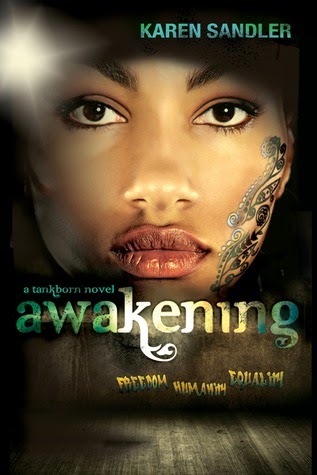
Awakening by Karen Sandler

November 21, 2013 |

I really enjoyed Tankborn, the first in Karen Sandler’s futuristic series featuring a world (called Loka) where some human beings are genetically engineered for hard labor and other undesirable tasks – a scientifically designed slave class. Our protagonist, Kayla, is one of these GENs – genetically engineered non-humans. At age 15, she was assigned to work for a powerful high-born man who turned out to be the leader of the Kinship, an organization dedicated to transforming the society on Loka, freeing GENs from their crippling restrictions, and gaining them rights of full humans – as the Kinship believes they are. Awakening continues this story, after Kayla has joined the Kinship in her own right.

While Tankborn focused on both Kayla and her best friend Mishalla, another GEN, Awakening focuses almost entirely on Kayla, with the majority of the story told from her third-person perspective. There’s a lot going on with Kayla in this installment. She struggles with her feelings for Devak, the grandson of the Kinship’s leader, a trueborn boy. There’s another GEN boy in the picture, Abran, who has secrets of his own. Then there’s the fact that Kayla keeps discovering things hidden in her brain, downloaded and installed there by an unknown person, that hint at a splinter group called FHE: Freedom, Humanity, Equality.

I assumed that much of the story would entail Kayla’s fight for equality with the Kinship, but that’s not quite the direction the book takes. Instead, a large part focuses on a disease affecting GENs (and only GENs) called Scratch. Even more mysteriously than the disease itself, which has no known cure, is the fact that some GENs seem to have the ability to heal others of Scratch simply by touch.

There’s a lot going on in the book, obviously, but I found it to be much slower than Tankborn despite this. It seems less focused and more meandering, with a few too many sections of dialogue where characters simply muse on what to do next instead of just doing it. A benefit to this, though, is that we get a lot more insight into Loka – its culture, its wildlife, and its environment. We learn more about Loka’s moons and their cycles, about the allabain people and their religious beliefs, about the history of the settlements. As a result, Loka feels like a living, breathing place, and it’s clear Sandler has put a lot of thought into making it seem so. Things like this are of huge interest to readers who love detailed world-building, but may be tedious for those who want a more plot-driven story.

I mentioned it in my review of Tankborn, but it bears mentioning again: Kayla is a black girl, and she is the star of this series. She’s not the best friend or the villain; she doesn’t even share protagonist status in this volume like she did in the first. What’s more, her face is prominently featured on the cover of the book. The series is published by Tu Books, an imprint of Lee and Low, who are dedicated to promoting culturally diverse books. In science fiction and fantasy, the lack of protagonists of color is a worrying problem, so books like this are essential.

While I don’t think this series will necessarily appeal to casual SF readers, it will most certainly appeal to seasoned ones, and I hope they’ll give it a try – it’s original, well-written, and unpredictable. We need to show that we want more SF stories like this featuring girls of color – and the way to do that is to read them, talk about them, and buy them.

Check back tomorrow for a twitterview with Karen Sandler addressing some of these things, plus a giveaway of a finished copy of Awakening.

Review copy provided by the publisher.

Filed Under: Reviews, Science Fiction, Uncategorized, Young Adult

  • « Previous Page
  • 1
  • …
  • 113
  • 114
  • 115
  • 116
  • 117
  • …
  • 237
  • Next Page »
  • Facebook
  • Instagram
  • Pinterest
  • Twitter

Search

Archives

We dig the CYBILS

STACKED has participated in the annual CYBILS awards since 2009. Click the image to learn more.

© Copyright 2015 STACKED · All Rights Reserved · Site Designed by Designer Blogs