• STACKED
  • About Us
  • Categories
    • Audiobooks
    • Book Lists
      • Debut YA Novels
      • Get Genrefied
      • On The Radar
    • Cover Designs
      • Cover Doubles
      • Cover Redesigns
      • Cover Trends
    • Feminism
      • Feminism For The Real World Anthology
      • Size Acceptance
    • In The Library
      • Challenges & Censorship
      • Collection Development
      • Discussion and Resource Guides
      • Readers Advisory
    • Professional Development
      • Book Awards
      • Conferences
    • The Publishing World
      • Data & Stats
    • Reading Life and Habits
    • Romance
    • Young Adult
  • Reviews + Features
    • About The Girls Series
    • Author Interviews
    • Contemporary YA Series
      • Contemporary Week 2012
      • Contemporary Week 2013
      • Contemporary Week 2014
    • Guest Posts
    • Link Round-Ups
      • Book Riot
    • Readers Advisory Week
    • Reviews
      • Adult
      • Audiobooks
      • Graphic Novels
      • Non-Fiction
      • Picture Books
      • YA Fiction
    • So You Want to Read YA Series
  • Review Policy

STACKED

books

  • STACKED
  • About Us
  • Categories
    • Audiobooks
    • Book Lists
      • Debut YA Novels
      • Get Genrefied
      • On The Radar
    • Cover Designs
      • Cover Doubles
      • Cover Redesigns
      • Cover Trends
    • Feminism
      • Feminism For The Real World Anthology
      • Size Acceptance
    • In The Library
      • Challenges & Censorship
      • Collection Development
      • Discussion and Resource Guides
      • Readers Advisory
    • Professional Development
      • Book Awards
      • Conferences
    • The Publishing World
      • Data & Stats
    • Reading Life and Habits
    • Romance
    • Young Adult
  • Reviews + Features
    • About The Girls Series
    • Author Interviews
    • Contemporary YA Series
      • Contemporary Week 2012
      • Contemporary Week 2013
      • Contemporary Week 2014
    • Guest Posts
    • Link Round-Ups
      • Book Riot
    • Readers Advisory Week
    • Reviews
      • Adult
      • Audiobooks
      • Graphic Novels
      • Non-Fiction
      • Picture Books
      • YA Fiction
    • So You Want to Read YA Series
  • Review Policy

“Best of 2013 YA” List Breakdown, Part 1

December 10, 2013 |

Welcome to the third annual “Best of YA” list break down. Since 2011, I’ve gone through the “best of” lists developed by the biggest trade review journals and pulled together some statistics about those books. Which ones have repeat appearances? Is there a gender representation difference in the books deemed the best? What do we see in terms of POC, LGBTQ representation, and lots more.

This year, I wanted to look at a number of factors like I did last year, and it requires more than one post to do so. Because I still had all of my data from last year pulled into a single space (I did not in 2011, where all of my information was posted in another forum), I’ve written third post as well, comparing the data from last year against this year’s. They will publish today, tomorrow, and on Thursday.

The “best of” lists I looked at this year are the same ones I analyzed last year: School Library Journal, Publishers Weekly, Kirkus, Horn Book, and the Library Journal list of Best YA for Adults. I like to look at that last one, the YA for Adults, because I think it’s worth keeping an eye on and comparing with the lists that are geared less toward adults — are there crossover titles? Are there different titles completely? It adds another flavor to the data.

Because they come out a little bit later, I have not looked at the best of lists from Booklist nor BCCB, though it’s possible I may look at them comparatively in the new year (BCCB’s list comes out in January and Booklist’s should be out this week, either prior to this post or after it). I limited what I looked at to YA fiction only. This means no graphic novels (though if you’re curious, the graphic novels which made this combination of lists include Boxers and Saints, on all five of the lists; Delilah Dirk and the Turkish Lieutenant on two of the lists; Will & Whit on one of the lists; Romeo & Juliet on one of the lists; and March on one of the lists) and I did not include non-fiction titles (of which there were very few).

I made my determination on whether a book was a YA book or not based on the criteria that Amazon listed it as a book for those age 12 and older. This meant some books which have been debated as being “for YA readers or not,” like Tom McNeal’s Far, Far Away, were indeed included in my count. I did not include illustrators for books that feature graphic or illustrative elements in my author counts or breakdowns.

Though more relevant to tomorrow’s post than today’s, I pulled my information about starred reviews from ShelfTalker’s last updated “The Stars So Far” post; since this was last updated in mid-November, it’s possible some of these titles may have earned additional stars since then. Information about LGBTQ representation in these books was pulled from Malinda Lo’s tallying, along with notes I’ve made to myself on the books I have read.

Before diving in, some caveats: none of this data means anything. I’m not trying to draw conclusions nor suggest certain things about the books that popped up on the “best of” lists. Errors here in terms of counts, in my decision to list a book as featuring a POC, in my tallying of MCs by gender, and so forth, are all my own. I have not read all of these books, so sometimes, I had to make an educated guess based on reviews I read. Tomorrow, I’ll link to all of my raw data in the introduction.

There were a total of 55 books on these lists, 55 authors, and a total of 62 main characters, as some books were told through more than one point of view.

With that, let’s see what there is to see in this year’s “Best of YA” lists.


Gender Representation in the “Best of” Lists


First, let’s look at gender and the “best of” lists. Do we have more male authors represented or do we have more female authors?

There were a total of 55 authors represented on all of the “best of lists,” with 14 being male and 41 being female. In other words, roughly three-quarters of the authors this year were female, while one-quarter were male. This is a really interesting breakdown, considering that the breakdown by author gender on the New York Times Lists (in this post and this post) showed something different.

One of the comments I received on my New York Times post breakdowns was that it would be interesting to look at the main character genders in the books listed. Since I didn’t look at that element in those posts, I thought I’d give it a shot with the “best of” lists this year.

As noted, there are more main characters than there are authors, so this is out of a total of 62 characters. Again, not having read all of the books, this is based on my best guesses having read through many reviews of the titles listed. I counted main characters as those who have a voice in the story. I did not include the Marcus Sedgwick book, since it is a collection of short stories and not having read it, making a call was impossible.

This chart tells quite a bit of a different story than the one above. Of the 62 main characters, 29 were male, and 33 were female. The percentages are much closer to even when we look at main character gender rather than look at the author’s gender alone.

There are a couple of questions to think about with this: Did we have much better male-led stories this year? Or do we tend to take male-led stories as “better” than those led by female? This is a question I’ve been thinking about a lot, as it’s something impossible not to think about. Female-led stories tend to have more romance in them, and it’s possible we have a bias against romance. Worthwhile readings on this topic are this post and this post over at Crossreferencing.

Again, I’m making no conclusions here, but I think these are questions worth thinking about. It does make me want to revisit my NYT analysis now and look at the gender of the main character, especially as some people took problem with the fact there was more male representation when it came to author appearance on the list. I have a suspicion that looking at the gender of the main characters of those books wouldn’t actually change my findings very much.

Debut Authors vs. More Seasoned Authors


What kind of break down is there between new authors and those who are on their second, fifth, or twentieth book? Are there more books by authors who’ve done their time on the “best of” lists or more by debut authors?

I am a purist when defining “debut.” These are first books. They are not first YA books. I did not hold published short stories or poems against debut status, as long as the book on the “best of” list was the author’s first novel. In other words, Alaya Dawn Johnson is not a debut author, despite The Summer Prince being her first YA book.

There were a total of 11 debut novels on the lists, making up 20% of the total. The other 44 novels were by authors who had previously published a novel.

What about gender of the debut author?

Of the 11 debut authors, nine were female and two were male.

Continuing to talk a bit about the debut novelists who made the list, how do the Morris Shortlist authors compare? Of the five books on the Morris list, three of those books saw themselves on any of the five “best of” lists: Carrie Mesrobian’s Sex & Violence, which made both Kirkus and PW’s “best of” list, In The Shadow of Blackbirds by Cat Winters made SLJ’s list, and Evan Roskos’s Dr. Bird’s Advice for Sad Poets, which made the Kirkus list. That’s more than half.

“Best Of” by Genre


It’s tough to decide what book belongs in what genre. There are some which could go more than one way (especially when it comes to historical and fantasy, as some could go either way easily). Again, since I haven’t read all of the books on this list, I had to pull some of my decisions from reviews, as well as from talking with those who have read the book. In short: decisions are subjective, but they’re based on research.

I broke down my categories as broadly as possible. Thus, “realistic” is a category and not contemporary, for the sake of putting books like Eleanor & Park into what might be the best place for it to fit. I considered Far, Far Away to be fantasy, rather than paranormal, as I determined paranormal a category best suited for a story featuring a creature, rather than a spirit. I know it’s a bit arbitrary.

Did one genre do better than another this year when it came to best of lists? Let’s take a look.

Turns out that realistic fiction led other genres in “best of” lists this year. Out of a total of 55 books, 24 were realistic fiction. Historical had 13, with fantasy 10, science fiction 5, paranormal 2, and short stories 1.

Perhaps there’s something to the suggestion there has been a growth in realistic fiction this year. This is something I may try to tackle in a series of posts next week about trends in 2014 fiction because I think it’s better said there might be a rise in a certain type of realistic fiction coming up.

Books by “Best of” List Frequency


How many books saw themselves on more than one “best of” list this year? Even though the staff of the journals choose their titles by vote (usually), it’s always curious to be to see what trends emerge in titles that appear more than once. Do those very early lists like School Library Journal’s in November influence those which appear later? Or more realistically, do awards like the National Book Award or the Horn Book/Boston Globe Book Award put titles onto radars as possible “best of” picks? What influences what, if anything?

It’s worth noting here — and I’ll repeat it again in the next posts — that the journals each choose a different number of “best of” titles. And with my criteria listed in the beginning of this post to define “YA Fiction,” the number of titles eligible shifted, too. Kirkus had 42 titles, School Library Journal had 13, LJ’s “YA for Adults” had 3, Horn Book had 5, and Publishers Weekly had 16. Again, I’ll come back to these totals in future posts.

Within the five lists, there were no books which appeared on all five. Only one book saw itself on four of the lists, and that was Eleanor & Park. It did not make the “Best YA for Adults” list by SLJ, though Rowell’s other book, Fangirl, did make that list.

There were five books which appeared on three lists, eleven books which appeared on two lists, and a total of thirty-eight books which appeared on one list.

The bulk of this year’s “best of” titles only showed up on one list.

“Best of” Titles by Book Format


This year seemed to be the year of novels with a twist to their format, and I think that some of the data on the “best of” list reflects that. Though this, too, is interesting to compare to last year’s list. Were there any verse novels this year? What about books told with a graphic-hybridization? What about sketches or illustrations that weren’t quite at graphic novel style or what about those mixed media projects?

It’s not surprising that standard novels made up the majority of format for storytelling. Forty-nine of the books on this list were your average novel (which isn’t a means of degrading novels as “average,” but rather suggesting they aren’t doing anything noteworthy in format). There were three novels this year that included some kind of illustrative element to them that stood out, including Maggot Moon, Winger, and The War Within These Walls. There was on graphic novel hybrid with Chasing Shadows, one mixed media novel with In The Shadow of Blackbirds, and one short story collection, Midwinterblood.

There were no novels in verse represented this year.

Diversity and “Best Of” Lists


Two topics I wanted to look at within the “best of” lists included representation of LGBTQ and POC. Again, standard disclaimers that I haven’t read all of these books, and I pulled data from my own research (as well as the linked-to blog post above from Malinda Lo).

First, let’s talk about LGBTQ and the “best of” lists. How many stories featured characters whose sexuality was discussed or a major part of the book? I’m looking strictly at the books and stories, rather than authors, because it’s challenging to make that determination and, I think, unfair to make it, too.

Five Books featured characters who identified as LGBTQ. These books were:

  • More Than This by Patrick Ness
  • The Sin-Eater’s Confession by Ilsa J. Bick
  • Two Boys Kissing by David Levithan
  • Winger by Andrew Smith (minor character)
  • Zero Fade by Chris L. Terry

What about books written by or featuring people of color? This one is easier to make a determination of when it comes to author, so I’m breaking this town into two data sets: by author and by character in a book. Remember there are 55 authors and 62 main characters represented.

Authors who are POC on the “Best of” lists: 8. I did include Myers twice in the count, since he had two different books on the list.

Main characters who are POC on the “Best of” lists: 10, with one story featuring a secondary character who is a POC.

Those authors and books (some of which are written by a POC about a POC) are:

  • Eleanor and Park by Rainbow Rowell 
  • Zero Fade by Chris L. Terry
  • Invasion by Walter Dean Myers 
  • Golden Boy by Tara Sullivan
  • Death, Dickinson, and the Demented Life of Frencie Garcia by Jenny Torres-Sanchez
  • Darius & Twig by Walter Dean Myers 
  • Champion by Marie Lu
  • The Summer Prince by Alaya Dawn Johnson
  • The Counterfeit Family of Vee Crawford-Wong by L Tam Howard
  • A Moment Comes by Jennifer Bradbury
  • Chasing Shadows by Swati Avasthi
  • Yaqui Delgado Wants to Kick Your Ass by Meg Medina

Country of Origin and “Best of” Lists

I wanted to round up today’s post and data by looking at something I did not look at last year, which is the country of origin of the author. Do authors who aren’t from the US fair well on our “best of” lists? Do they tend to do better than US authors?

I’ve got three categories for this data: US born and still living in the US; foreign born and foreign living; and I have a small number of US ex-pats. Here’s the breakdown:

Of the 55 authors represented on the “best of” lists, 40 were from and still living in the US. A total of 12 were foreign born and foreign living, and three were born in the US and now living in a foreign country. 
There’s not anything to conclude with this information, but it’s interesting to see there is a fair representation of non-US authors on the list. The bulk were located in the UK, Canada, and Australia. 
***
Any thoughts on the data so far? Surprises? Non-surprises? 
Tomorrow there will be another post, this time looking at a number of other factors, including date of publication for the books on the lists, the spread of publishers represented on the list, and more. I’ll talk about the way this year’s “best of” lists compare to last year’s on Thursday, since there are some interesting trends in the books on these lists. 
Even if no conclusions can be made, it is always fascinating to see what a year in books looks like and what it is we define as “the best” in a year (and it’s equally or more fascinating to see what’s not included).

Editing to add that Malinda Lo has some really great observation and commentary about LGBTQ as represented on this year’s “Best of” lists. Go check it out.

Filed Under: best of list, data, Data & Stats, Uncategorized, Young Adult

November and December Debut YA Novels

December 6, 2013 |

Since both November and December are quieter months when it comes to debut novels this year, rather than having two separate posts, I’d combine the two. This will be the last roundup of debut novels out in 2013, but you can catch up on previous posts by checking out October’s debut post and working backwards from there. 

Did you see this week’s announcement of the YALSA Morris contenders? Check out the 5 books honored on the short list. This is probably my favorite of the awards lists, as it rewards not just a well-done debut novel, but it looks at both appeal to readers and the potential for that author to continue producing excellent work in the future. 

As usual, if I’ve missed a traditionally-published debut novel that came out in November or will be coming out this month, let me know in the comments. All descriptions are from WorldCat, unless otherwise noted.

After Eden by Helen Douglas: Eden, sixteen, must choose between helping Ryan, a time-traveler, and her best friend Connor who, according to Ryan, is about to become famous through a significant scientific discovery that will, ultimately ruin the world.

Cracked by Eliza Crewe: Meet Meda. She eats people. Well, technically, she eats their soul. But she can’t help being a bad guy. She knows she’s different and the only other person who could have told her about other “soul-eaters” is now dead. That is, until the three men in suits show up. They can do what she can do. They’re like her. Meda might finally be able to figure out what she is and why the Hunger with her for souls is growing. The problem? They want to kill her.

Control by Lydia Kang: In 2150, when genetic manipulation has been outlawed, seventeen-year-old Zelia must rescue her kidnapped sister with the help of a band of outcasts with mutated genes.

These Broken Stars by Aime Kaufman and Meagan Spooner: Two star-crossed lovers must fight for survival when they crash land on a seemingly uninhabited planet. Note that Kaufman is the debut author with this book, but Spooner debuted in August 2012 with Skylark. 

The Promise of Amazing by Robin Constantine: Wren Caswell is average. Ranked in the middle of her class at Sacred Heart, she’s not popular, but not a social misfit. Wren is the quiet, “good” girl who’s always done what she’s supposed to—only now in her junior year, this passive strategy is backfiring. She wants to change, but doesn’t know how. Grayson Barrett was the king of St. Gabe’s. Star of the lacrosse team, top of his class, on a fast track to a brilliant future—until he was expelled for being a “term paper pimp.” Now Gray is in a downward spiral and needs to change, but doesn’t know how. One fateful night their paths cross when Wren, working at her family’s Arthurian-themed catering hall, performs the Heimlich on Gray as he chokes on a cocktail weenie, saving his life literally and figuratively. What follows is the complicated, awkward, hilarious, and tender tale of two teens shedding their pasts, figuring out who they are—and falling in love. (via Goodreads)

Have you had any favorite debut novels this year? I’d love to know what you dug in the comments and what you’re looking forward to in 2014. 

Filed Under: debut authors, Uncategorized, Young Adult

The To-Read Pile

December 4, 2013 |

I have a little problem when it comes to my reading. I’m sure I’m not alone in it. I turn the last page on a book I thoroughly enjoyed and eagerly start my search for the next one. Except…I have a hard time finding just the right book for my mood at the time. I pick one up, set it down, pick up another. I scan the stacks at various places around the house, knowing that multiple books are calling my name, but unsure how to decide just which one is calling my name the loudest. Before I know it, I’ve spent an hour just wandering the house and haven’t read a thing.

I’m in one of those places right now. Below are a few of the books that I’m considering as my next read, but haven’t really dove into any of them yet. The first paragraphs are descriptions from Worldcat, and my own commentary follows in the second paragraphs.

Enders by Lissa Price
With the Prime Destinations body bank destroyed, Callie no longer has to
rent herself out to creepy Enders–but he can still get inside her mind
and make her do things she doesn’t want to do. Having the chip removed
could save Callie’s life — but it could also silence the voice in her
head that might belong to her father.

I dug Starters, and I hope that this sequel will prove to be just as fun as the first. I have to admit, I feel this one’s call a bit stronger than the others. (I loathe this cover, though. About the same amount I loathed the cover for the first. Sigh.)

Plus One by Elizabeth Fama
In an alternate United States where Day and Night populations are forced
to lead separate–but not equal–lives, a desperate Night girl falls
for a seemingly privileged Day boy and places them both in danger as she
gets caught up in the beginnings of a resistance movement.

I really liked Fama’s previous novel, Monstrous Beauty, a nicely written historical fantasy, and this (unrelated) book sounds intriguing. The concept sounds a little far-fetched (there’s no explanation given initially for the division between night and day), but I have faith the story will make me believe in it. (And as we’ve already discovered, it’s not hard for me to suspend my disbelief.)

Control by Lydia Kang

In 2150, when genetic manipulation has been outlawed,
seventeen-year-old Zelia must rescue her kidnapped sister with the help
of a band of outcasts with mutated genes.
 
The review copy states that Kang, a practicing physician, has “gained a reputation for helping other writers with medical accuracy in their own novels.” I’m interested to see how technical this book is and how much of it is based on actual science rather than, ahem, “science.”

The Enchanter Heir by Cinda Williams Chima
Racing against time, Jonah and Emma, who possess unique magical gifts,
work to uncover the truth about Thorn Hill, a peaceful commune that the
Wizard Guild claims is a hotbed of underguild terrorists.

I’ve been meaning to read Chima’s fantasy novels for ages, but I’ve never managed to find the first in any of her series in at the library when I’ve remembered to look. This is the first in a duology related to the Heir Chronicles, but it’s supposed to function separately, so I figure it’s a good place to start.

Cress by Marissa Meyer
No Worldcat summary yet, but I can tell you this is the third book in Meyer’s series of futuristic fairy tale re-tellings. It’s based on Rapunzel and features a girl trapped on a satellite who’s become very good at hacking – and gets caught up in Cinder and Scarlet’s adventures, naturally.

Some slightly tepid reviews from a few acquaintances have me holding off on this one for a while. I know I’ll get around to it sooner rather than later, though.

All Our Yesterdays by Cristin Terrill
Em must travel back in time to prevent a catastrophic time machine from
ever being invented, while Marina battles to prevent the murder of the
boy she loves.

I love time travel, but it can be difficult to do well. When plotted right, time travel can be some of the smartest storytelling around. Reviews from people I trust indicate that Terrill does it very well here.

Filed Under: Uncategorized, What's on my shelf, Young Adult

Get Genrefied: Humor

December 3, 2013 |

Every month at STACKED, we’re highlighting a genre or subgenre within YA literature, talking about the key elements and some of the recent offerings fitting within it. This started as part of Angela’s reader’s advisory challenge, and so far we’ve covered steampunk, horror, science fiction, high fantasy, mysteries and thrillers, verse novels, contemporary realistic, historical fiction, graphic novels, romance, and dystopia. This month, we’re tackling the last and final genre, humor. 

Because we have loved writing this series so much, we want to keep it going through next year, as well. We’ve got some ideas for genres we’d like to tackle, but included at the end of this guide, there is a very short survey asking you if there’s a genre you’d like to know about so we can add it to our list of possibilities. 

Humor, like horror, isn’t so much a genre as it is a mood or tone of a book. Every genre can feature humor within it — there are humorous science fiction novels, fantasy novels, horror novels, and so on. Also like horror, humor can be really dark or it can be really light. There are dark satires and there are lighter comedic romances. There’s also plenty of room for humor in YA non-fiction, particularly when it comes to teen memoirs. 

Humor a characteristic, and it’s the sort of characteristic that is entirely subjective to the reader. What one person finds as humorous another person might not understand as funny. There are many books that have funny elements, even when they tackle a difficult subject matter. Some readers may appreciate and see it as humorous while others may see the difficult topic tackled as setting the tone of the book instead. An entire book doesn’t need to be knee-slapping funny to be considered humorous: it just needs to have moments of funny within it to fit as humorous. 

Jennifer Brannon notes in her guide to humor at Novelist, humor is both subjective and situational. It depends on the reader’s mood as much as the reader’s sense of humor, as well as the situation and subjective views of the characters in the story being read. But on the most basic level, humor just makes someone laugh. 

There are surprisingly few resources available on the topic of humor in YA fiction, and part of the reason is because it’s such a subjective aspect of a novel. That doesn’t mean that appreciation for humor doesn’t exist at all; readers and reviews often point out when a book is funny, and there are authors who can be pretty easily pointed to as those who frequently pen humorous stories. A few resources worth knowing about or keeping an eye on though:

  • Humor Writers of America: though their website is bare bones, this new organization is meant to be a gathering spot for those who do write humor. One of the founders, Adam Selzer, may be familiar. He’s written a few YA books, including the humorous I Kissed a Zombie and I Liked It. The site has a small directory of current members, which might be helpful in scoping out some new names in humor writing.
  • The Society of Children’s Book Writers and Illustrators offers an annual award for its members who write humor called the Sid Fleischman Humor Award. The SCBWI keeps a record of those who’ve received the award on their website.
  • As of this writing, there isn’t a specific category for YA humor, but the Thurber House presents the annual Thurber Prize for American Humor. 
  • Molly Wetta developed this awesome flow chart to YA-friendly humor, which is well worth having on hand for readers who “want to read something funny,” but might not be able to explain exactly what they’re looking for in a funny book. 
Here’s a look at the wide-range of humor in YA fiction. As you likely remember, last month we did a big roundup of contemporary YA fiction featuring humor, which was kicked off with a guest post from author Maurene Goo on why it is she writes and appreciates funny in her stories. I’ve left those authors and titles off this round up and instead focused at humor across a variety of genres. All descriptions come from WorldCat, and I’ve tried to stick to books published in the last few years. Feel free to jump in with other titles and authors whose books would fit with humor. 
Some authors to have on your radar for those seeking a funny YA book include Meg Cabot, Carl Hiaasen, Lemony Snicket, David Lubar, Louise Rennison, Ally Carter, Gordon Korman, and Josh Berk. You’d also do well handing over Douglas Adams, who has great crossover appeal and humor that translates. 

Beauty Queens by Libba Bray: When a plane crash strands thirteen teen beauty contestants on a mysterious island, they struggle to survive, to get along with one another, to combat the island’s other diabolical occupants, and to learn their dance numbers in case they are rescued in time for the competition.

Mothership by Martin Leicht and Isla Neal (first in series): In 2074, while attending the Hanover School for Expecting Teen Mothers aboard an earth-orbiting spaceship, sixteen-year-old Elvie finds herself in the middle of an alien race war and makes a startling discovery about her pregnancy.

Hold Me Closer, Necromancer by Lish McBride: Sam LaCroix, a Seattle fast-food worker and college dropout, discovers that he is a necromancer, part of a world of harbingers, werewolves, satyrs, and one particular necromancer who sees Sam as a threat to his lucrative business of raising the dead.

Nation by Terry Pratchett: After a devastating tsunami destroys all that they have ever known, Mau, an island boy, and Daphne, an aristocratic English girl, together with a small band of refugees, set about rebuilding their community and all the things that are important in their lives.

Oh. My. Gods. by Tera Lynn Childs: When her mother suddenly decides to marry a near-stranger, Phoebe, whose passion is running, soon finds herself living on a remote Greek island, completing her senior year at an ancient high school where the students and teachers are all descended from gods or goddesses.

Sean Griswold’s Head by Lindsey Leavitt: After discovering that her father has multiple sclerosis, fifteen-year-old Payton begins counseling sessions at school, which lead her to become interested in a boy in her biology class, have a falling out with her best friend, develop an interest in bike riding, and eventually allow her to come to terms with life’s uncertainties.

Notes From the Blender by Trish Cook and Brendan Halpin: Two teenagers–a heavy-metal-music-loving boy who is still mourning the death of his mother years earlier, and a beautiful, popular girl whose parents divorced because her father is gay–try to negotiate the complications of family and peer relationships as they get to know each other after learning that their father and mother are marrying each other.

So Punk Rock (And Other Ways to Disappoint Your Mother) by Micol Ostow: Four suburban New Jersey students from the Leo R. Gittleman Jewish Day School form a rock band that becomes inexplicably popular, creating exhiliration, friction, confrontation, and soul-searching among its members.

You Killed Wesley Payne by Sean Beaudoin: When hard-boiled, seventeen-year-old private investigator Dalton Rev transfers to Salt River High to solve the case of a dead student, he has his hands full trying to outwit the police, negotiate the school’s social hierarchy, and get paid.

Does My Head Look Big In This? by Randa Abdel-Fattah: Year Eleven at an exclusive prep school in the suburbs of Melbourne, Australia, would be tough enough, but it is further complicated for Amal when she decides to wear the hijab, the Muslim head scarf, full-time as a badge of her faith–without losing her identity or sense of style.

fml by Shaun David Hutchinson: At a party near the end of senior year, seventeen-year-old Simon Cross imagines his life with and without Cassie, the girl he has yearned for since they were freshman, and begins to discover the unpredictable wonders of life his best friends, Ben and Coop, have urged him to explore.

Sucks to Be Me by Kimberly Pauley (also the sequel): When sixteen-year-old Mina is forced to take a class to help her decide whether or not to become a vampire like her parents, she also faces a choice between her life-long best friend and the boy she has a crush on versus new friends and possible boyfriends in her mandatory “vampire lessons.”

Bubble World by Carol Snow: After sixteen-year-old Fresia learns–and tells her friends–that their perfect life on a luxurious tropical island is not real, she is banished from her virtual world to the “mainland,” where people are ugly, school is hard, and families are dysfunctional.

Two Lies and a Spy by Kat Carlton: Sixteen-year-old Kari juggles saving her spy parents while impressing the guy she has been in love with forever.

There is No Dog by Meg Rosoff: When the beautiful Lucy prays to fall in love, God, an irresponsible youth named Bob, chooses to answer her prayer personally, to the dismay of this assistant, Mr. B who must try to clean up the resulting catastrophes.

Gorgeous by Paul Rudnick: When eighteen-year-old Becky Randle’s mother dies, she is whisked away
from a trailer park to New York City, where fashion designer Tom Kelly
offers to transform her into a glamorous Rebecca, a girl fit for a
prince–but soon she begins to fear that she will lose touch with her
real self.

Etiquette & Espionage by Gail Carriger: In an alternate England of 1851, spirited fourteen-year-old Sophronia is
enrolled in a finishing school where, she is suprised to learn, lessons
include not only the fine arts of dance, dress, and etiquette, but also
diversion, deceit, and espionage.

Skulduggery Pleasant by Derek Landy: When twelve-year-old Stephanie inherits her weird uncle’s estate, she
must join forces with Skulduggery Pleasant, a skeleton mage, to save the
world from the Faceless Ones. (This one skews middle grade.)

Carter Finally Gets It by Brent Crawford: Awkward freshman Will Carter endures many painful moments during his
first year of high school before realizing that nothing good comes
easily, focus is everything, and the payoff is usually incredible.

Croak by Gina Damico: A delinquent sixteen-year-old girl is sent to live with her uncle for
the summer, only to learn that he is a Grim Reaper who wants to teach
her the family business.

***
We’d love to know if there are genres (or moods, like humor) our readers are interested in having us write guides to in 2014. Should we stick to big genres or is there an interest in subgenres? Some of the ones we’ve got in mind to cover include urban fiction, urban fantasy, inspirational fiction, non-fiction, fairy tale retellings, satires, and westerns. Let us below know if any of these are of interest and/or what else you’d love to know more about that we haven’t already covered. 

Filed Under: genre fiction, Get Genrefied, humor, Uncategorized, Young Adult

Hardcover to Paperback: Six YA Book Makeovers to Consider

December 2, 2013 |

Let’s do another round of hardcover to paperback makeovers, shall we? Every season, it’s fun to see what books are getting new looks, but it’s even more interesting to wonder whether the new covers nail the story better than the original. As usual, some of these are great changes and some definitely are not.

I picked up a copy of Steven Arntson’s The Wrap-Up List quite a while ago but never got around to reading it. I love the envelope cover, which is the initial hardcover look. It’s a really simplistic design, but it tells the reader quire a bit about the story. It’s gender-neutral, and it looks like the kind of book that could have good readership across age groups because there’s not a person on there nor is there an image that could be dated. But the argument here could be the exact opposite of what I’ve said: because it’s so simplistic a cover, it maybe doesn’t tell you anything about the story or about the intended audience of it. It’s possible that’s why I haven’t picked it up yet — I don’t know whether it’d fit whatever reading mood I’m in because I don’t know what it’s about. It’s not necessarily iconic nor memorable.

The paperback redesign on the right is also simplistic, but the addition of the tag line actually adds a lot to explaining what the story is about. This is a story about someone coming to terms with the end of their life! The wrap-up list then likely refers to the things they’re hoping to “wrap up” before they don’t have the time to do so any longer. The paperback also seems to “age” the book into a category a little bit more, too: it’s a torn piece of notebook paper, and the title itself is handwritten in pen. The note looks like it’s taped on the top of a student test. It’s a book meant for teen readers.

For me, this is a pretty even exchange. I think the paperback better targets the readership, but I don’t think either one is necessarily bad nor is either one outstanding. The Wrap-up List will be out in paperback from Houghton Mifflin Harcourt in paperback on May 13, 2014.

One of the things that made Out of the Easy‘s hardcover stand out to me was the color. It’s a couple of shades of really stand-out green, and it’s easy to spot on shelves. The cover image itself isn’t necessarily the most memorable, though. The girl looking at the bird cage fits the story (in a metaphoric sense), but I don’t know if it’s an iconic cover overall. It does, however, say this is a YA book. What’s interesting to pay attention to on the hardcover is what’s pulled out. The author’s name is large and noticeable, as is the title. But what caught my eye was that it notes she’s a New York Times Bestselling author. Hold that for a minute.

The paperback redesign, available March 4, does nothing for me. It reminds me a lot of an adult fiction novel, perhaps something literary or perhaps something geared toward female readers — I don’t want to call it chick lit nor women’s fiction, but that’s the vibe of the cover I’m getting. It’s kind of boring and forgettable in a way that the hardcover edition isn’t. It’s faded out, and even the lone hanging shirt and suitcase to me say something about the forgettable quality of the image. Check out, though, how the title and author treatments are different on the paperback: Ruta’s name is much larger and more noticeable, as she takes up two lines and nearly 1/3 of the real estate on the cover. The title, in contrast, is very small and positioned in such a way it’s easy to overlook. Rather than having Ruta called out as a NYT Bestseller by her name, she’s noted instead as an internationally best selling author (though the NYT recognition comes, too, just later on on the cover). And then there’s a blurb from Entertainment Weekly, too. For me, this cover is angled specifically at adult readers, rather than teen readers. It has a big name publication giving it acclaim, two notes of the author’s sales capabilities, and a cover that looks somewhat generic and inoffensive.

For me, the hardcover is much stronger than the paperback here for YA readers. Though for adult readers, I suspect the paperback is more appealing.

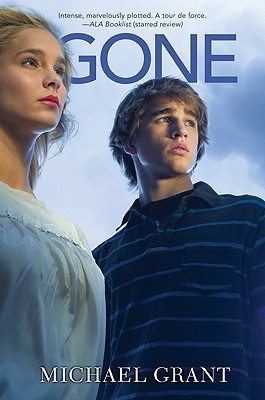
Michael Grant’s Gone series is getting a new makeover in paperback. Right now, the paperback editions of the hardcover books have the same cover, but with the publication of the final book in the series, the paperbacks are going in a new direction. So on the left, the hardcover edition of Gone, the first in the series. It’s a fairly generic — and I’ll even say unattractive — cover. Two people looking in the distances. They don’t really have anything memorable about them. But I’d say if anything, the original cover is gender neutral, even if it doesn’t tell you anything about the book itself. There is a tagline on the hardcover, “This is the way the world ends,” but that tag line in the original paperback edition changes. It’s instead a pull quote from a Booklist review. Later books in the series don’t have a tag line, but a pull quote from Stephen King.

I note the Stephen King pull quote because in the new paperback edition, shown on the right, it’s there but easy to miss. The white font sort of fades into the bright coloring of the background. For the most part, I dig this makeover. It’s gender neutral in the same way that the original covers are, but it gets rid of the people who are on it. And while I think they’re gender neutral, part of me wonders if the makeover helps give these books even more boy appeal than they originally had: they look more like action novels than they do Serious Stories with people on the front. Also worth noting that Grant’s name is much bigger on the new paperbacks, as is his distinction as a New York Times Bestseller.

For me, the new paperbacks are winners here. I think they’re much more appealing and they stand out. The other covers look like any number of other series (think Kevin Emerson’s series, for one).

To a cover makeover I don’t get at all: Robin LaFevers’s Dark Triumph. On the left, the original cover. I know very little about the time setting and story here, aside from what Kimberly’s written, so I don’t know about accuracy or relevancy to the story. But I know so much that this cover fits very well with the cover for the first book in the series, Grave Mercy. I like the tag line “Vengeance is divine,” and I like that this series has done a really good job of noting that it’s part of the His Fair Assassin series. It’s a very small detail, but it’s something worth its weight in a library setting for readers, as well as for those who help readers but may not be familiar with YA books. Overall, the cover on the left just fits.

But the paperback is getting a different look — but it’s a very small different look. The title and author treatments are identical, as are the tag line and noting of the series at the top of the cover. What’s changed is that the girl in the image is no longer looking from the side out, but she’s instead looking straight on at the reader. She’s not wearing a head covering, but instead, her hair is hanging down and loose. She doesn’t necessarily look like she belongs in a period in history in this cover. She looks very modern. Even somewhat goth. Rather than have her dagger to her chest, she’s now got it pointed out. This is a very action-oriented cover in the way that the other image is not. What’s interesting, too, is how the background’s changed. There’s light behind her in the paperback, where there is nothing but a closed space in the hardcover.

This isn’t a bad makeover in the least. I like that the designers took care to keep the style so similar that it won’t look weird when paired with Grave Mercy, which has not received a makeover in paperback form. But I can’t help wondering why the change? Was there something in the text that makes the paperback more true to the story than the hardcover? If anyone has read this one and wants to weigh in — whether one is a better and more truer design than the other — I’d love to know. Perhaps it has to do with historical accuracy?

The paperback edition of Dark Triumph will be available April 1.

It feels like I read Without Tess by Marcella Pixley a long time ago, and when I go back into my reviews, it turns out that I read and reviewed this one in September 2011. The hardcover on the left is very quiet, and I think it reflects the story quite well. I really like the title treatment and the use of the words and font down the front. They stand in place of any kind of tag line or blurb. The author’s name is small and in the corner, but it’s not hard to see and it stands out in dark gray against the stark white of the rest of the cover.

Of course, the quiet cover means that it doesn’t stand out on a shelf, nor does it necessarily give the reader any insight into what the story is about. But there is something to be considered about how the cover conveys tone very well here.

The paperback of Without Tess will release May 13, 2014, which is quite a long time between the initial publication in hardcover in 2011. Like the original, the cover here is also quiet, but it seems to be a different kind of quiet. This cover reflects the content a little bit more, and it portrays the sense of loss in a way that the flower and handful of words do not in the original. There’s been an addition of a blurb from Francisco X. Stork on the cover, which I think is a really nice name to have giving Pixley’s book some props — readers who dig the kind of quiet story Stork writes will likely find this one to be a good read. What I don’t like about the paperback, though, is the title font treatment. The color is right but I think that the font itself looks very young, casting this much more as a middle grade novel than as a young adult. Maybe it’s my screen resolution, but it looks as though there are small white lines aiming up toward the font, too, which only furthers the juvenile feeling. I also note that Pixley’s name is done in a thin, white font that is easy to miss with the blue background.

I think the hardcover of this book is much stronger, but I wouldn’t be surprised if the paperback has more appeal to a wider range of readers.

Anna Collomore’s psychological thriller The Ruining came out earlier this year with the cover on the left. It’s an eye-catching one: there’s the girl half underwater with the massive mansion in the back. It’s a neat contrast and a nice metaphor. I feel like this is quite a memorable cover because it’s so different. There’s not a blurb nor is there a tag line on the original cover. The title and the author’s name are done in pretty standard fonts that don’t detract from the greater image.

The paperback edition of Collomore’s The Ruining will be available February 6, 2014. And it’s completely different than the original cover: there’s a closeup of a girl who looks way, way older than a teenager. She’s clearly upset about something, and she looks slightly off. It’s a memorable facial expression, for sure. There’s a girl in the background, too, though little could be said about her expression nor of her body language because she’s so far back. Is she turning a light switch on or off? Is she just holding the wall to stay standing up? I like the pop of yellow and white that the wall brings to the cover, and I think that the pink used for the author’s name stands out nicely, too. But the title itself seems to get lost in this image in a way that doesn’t make the image stand out. It’s just easy to overlook. There’s a pull quote from a Kirkus review, too: “gripping stuff.” I don’t know how much that tells anyone anything about the book, nor do I think it helps give the cover something new or different, either.

It feels like this cover isn’t aimed at teen readers. It looks like the kind of cover you’d find in the adult section, and it’s really possible the target is adult readers here. If the girl looked younger, perhaps I’d feel differently. But she doesn’t look like she’s a teen. She also looks heavily photoshopped (unless that’s just my computer’s screen resolution). Either way, the new paperback doesn’t stand out to me and it’s easily forgettable in a way that the hardcover isn’t. You wouldn’t know this is a psychological thriller.

Hardcover wins this one, hands down.

So of the covers above, what do you think? Which ones are winners and which ones could have stuck to the original and been better?

Filed Under: aesthetics, cover designs, Cover Redesigns, Uncategorized, Young Adult

  • « Previous Page
  • 1
  • …
  • 112
  • 113
  • 114
  • 115
  • 116
  • …
  • 237
  • Next Page »
  • Facebook
  • Instagram
  • Pinterest
  • Twitter

Search

Archives

We dig the CYBILS

STACKED has participated in the annual CYBILS awards since 2009. Click the image to learn more.

© Copyright 2015 STACKED · All Rights Reserved · Site Designed by Designer Blogs