• STACKED
  • About Us
  • Categories
    • Audiobooks
    • Book Lists
      • Debut YA Novels
      • Get Genrefied
      • On The Radar
    • Cover Designs
      • Cover Doubles
      • Cover Redesigns
      • Cover Trends
    • Feminism
      • Feminism For The Real World Anthology
      • Size Acceptance
    • In The Library
      • Challenges & Censorship
      • Collection Development
      • Discussion and Resource Guides
      • Readers Advisory
    • Professional Development
      • Book Awards
      • Conferences
    • The Publishing World
      • Data & Stats
    • Reading Life and Habits
    • Romance
    • Young Adult
  • Reviews + Features
    • About The Girls Series
    • Author Interviews
    • Contemporary YA Series
      • Contemporary Week 2012
      • Contemporary Week 2013
      • Contemporary Week 2014
    • Guest Posts
    • Link Round-Ups
      • Book Riot
    • Readers Advisory Week
    • Reviews
      • Adult
      • Audiobooks
      • Graphic Novels
      • Non-Fiction
      • Picture Books
      • YA Fiction
    • So You Want to Read YA Series
  • Review Policy

STACKED

books

  • STACKED
  • About Us
  • Categories
    • Audiobooks
    • Book Lists
      • Debut YA Novels
      • Get Genrefied
      • On The Radar
    • Cover Designs
      • Cover Doubles
      • Cover Redesigns
      • Cover Trends
    • Feminism
      • Feminism For The Real World Anthology
      • Size Acceptance
    • In The Library
      • Challenges & Censorship
      • Collection Development
      • Discussion and Resource Guides
      • Readers Advisory
    • Professional Development
      • Book Awards
      • Conferences
    • The Publishing World
      • Data & Stats
    • Reading Life and Habits
    • Romance
    • Young Adult
  • Reviews + Features
    • About The Girls Series
    • Author Interviews
    • Contemporary YA Series
      • Contemporary Week 2012
      • Contemporary Week 2013
      • Contemporary Week 2014
    • Guest Posts
    • Link Round-Ups
      • Book Riot
    • Readers Advisory Week
    • Reviews
      • Adult
      • Audiobooks
      • Graphic Novels
      • Non-Fiction
      • Picture Books
      • YA Fiction
    • So You Want to Read YA Series
  • Review Policy

Going Graphic: Graphic Novels on the Outstanding Books for the College Bound List

April 10, 2014 |

In continuing the short reviews and discussion of the titles on this year’s Outstanding Books for the College Bound list (OBCB), I thought I’d hit on format in this roundup, rather than thematic connections. One of the things that makes me really proud of the work we did on this list was that we included a nice number of graphic novels and graphic non-fiction titles. Even though it seems like those who are huge readers have been “on to” graphic books forever, it’s still a format not everyone widely accepts as a legitimate type of reading. The books that we were able to include in a list of books for those who want to attend college or who are life long learners in the graphic format definitely prove otherwise — included here are both fiction and non-fiction graphic novels, as well as a couple of graphic novel hybrids.

These titles spanned all of the categories on the OBCB list, so I haven’t read them all personally. Because of that, I’m going to format this roundup a little bit differently than the previous formats. I’ll offer up the official WorldCat description for each, and then for the titles I have read or have more to elaborate upon, I’ll note that beneath.

As a bonus, many of the graphic novels are also diverse titles. 


March: Book One by John Lewis, Andrew Aydin, and Nate Powell: John Lewis’s autobiographical account of his lifelong battle for civil rights for all Americans.

I didn’t get a chance to read this one, but it looks like an outstanding (auto)biographical work about John Lewis’s life and how much a role he played during the civil rights movement. 

Philosophy: A Discovery in Comics by Margreet De Heer: A fun introduction in comics to deep thinking and the history of philosophy. 

The WorldCat description tells you everything and nothing about this little gem. It is a fun introduction to the history of philosophy, but it’s more than that. While it definitely offers a solid history, the core of the book is about how readers can learn to develop their own ideas about philosophy and figure out what their own philosophy on life is. It’s easy to follow and it’s not going to go over the heads (nor bore!) readers who may not be interested in philosophy or those who think that philosophy is a tough, hard-to-grasp concept. This makes it really easy. 

Relish: My Life in the Kitchen by Lucy Knisley: Lucy Knisley loves food. The daughter of a chef and a gourmet, this talented young cartoonist comes by her obsession honestly. In her forthright, thoughtful, and funny memoir, Lucy traces key episodes in her life thus far, framed by what she was eating at the time and lessons learned about food, cooking, and life. Each chapter is bookended with an illustrated recipe– many of them treasured family dishes, and a fewof them Lucy’s original inventions. 

I reviewed this book last year, well before deciding to nominate it for OBCB consideration. What made this a standout and one we decided to put on the Arts & Humanities list was how much love was poured into food and eating. This is the kind of book anyone — from a passionate foodie to a person who merely enjoys a good meal now and then to the reader who has never thought much about the food they eat — could get into. Knisley’s art is really enjoyable, and her ability to be respectful of the way food connects us as people and the way food becomes a centerpiece to our lives gets at the heart of arts and humanities. 

American Born Chinese by Gene Luen Yang: Alternates three interrelated stories about the problems of young Chinese Americans trying to participate in the popular culture. Presented in comic book format.

That’s not the most useful WorldCat description, but it’s pretty spot on about what the book is. It’s been a long time since I read this one — back in grad school is when I think I read it — but it’s one that’s stuck with me not just because it’s three interconnected stories about the Chinese-American experience, but also because of how outstanding the artwork is. This is easily a classic of YA literature and of graphic novels for young readers (if not graphic novels, period) and it’s a perfect fit for the list.

Feynman by Jim Ottaviani and Leland Myrick: In this substantial graphic novel biography, First Second presents the larger-than-life exploits of Nobel-winning quantum physicist, adventurer, musician, world-class raconteur, and one of the greatest minds of the twentieth century: Richard Feynman. Written by nonfiction comics mainstay Jim Ottaviani and brilliantly illustrated by First Second author Leland Myrick, Feynman tells the story of the great man’s life from his childhood in Long Island to his work on the Manhattan Project and the Challenger disaster. Ottaviani tackles the bad with the good, leaving the reader delighted by Feynman’s exuberant life and staggered at the loss humanity suffered with his death. 

War Brothers: The Graphic Novel by Sharon McKay and Daniel Lefrance: Jacob is a 14-year-old Ugandan who is sent away to a boys’ school. Once there, he assures his friend Tony that they need not be afraid — they will be safe. But not long after, in the shadow of the night, the boys are abducted. Marched into the jungle, they are brought to an encampment of the feared rebel soldiers. They are told they must kill or be killed, and their world turns into a terrifying struggle to endure and survive.

This is a title I didn’t get my hands on, despite being on one of my own subcommittee’s lists. If you’ll remember, one of the things I talked about in terms of the committee process is that sometimes, you don’t get to read everything (in this case, the book was too new and I couldn’t get it at work, nor could I interlibrary loan it) but a good argument and discussion by those who did read it can persuade you to consider it worth including on the list. I’ve since acquired it for my library and look forward to checking it out. 

The Absolutely True Diary of a Part-Time Indian by Sherman Alexie: Budding cartoonist Junior leaves his troubled school on the Spokane Indian Reservation to attend an all-white farm town school where the only other Indian is the school mascot.

Alexie’s novel isn’t a straight graphic novel — it’s a hybrid. It’s been years since I read this one, but like with Yang’s title, it’s a staple of YA lit and it’s a perfect fit for the Literature and Languages list. This could have easily fit, too, on the History and Cultures list. 

Chasing Shadows by Swati Avasthi and Craig Phillips: Chasing Shadows is a searing look at the impact of one random act of violence. Before: Corey, Holly, and Savitri are one unit– fast, strong, inseparable. Together they turn Chicago concrete and asphalt into a freerunner’s jungle gym, ricocheting off walls, scaling buildings, leaping from rooftop to rooftop. But acting like a superhero doesn’t make you bulletproof. After: Holly and Savitri are coming unglued. Holly says she’s chasing Corey’s killer, chasing revenge. Savitri fears Holly’s just running wild– and leaving her behind. Friends should stand by each other in times of crisis. But can you hold on too tight? Too long? In this intense novel, told in two voices, and incorporating comic-style art sections, Swati Avasthi creates a gripping portrait of two girls teetering on the edge of grief and insanity. Two girls who will find out just how many ways there are to lose a friend– and how many ways to be lost. 

I reviewed Avasthi’s title before I nominated it for our list and I still stand behind everything in that review for why it belongs on the OBCB list. One other reason is that this story is set in that strange time period between the end of high school and whatever comes next. Though there have been more of those books in recent years, Avasthi’s handling of the social elements in that time frame — friendship, specifically — really makes it stand out. This, like Alexie’s book, is a graphic hybrid, rather than a solid graphic novel. 

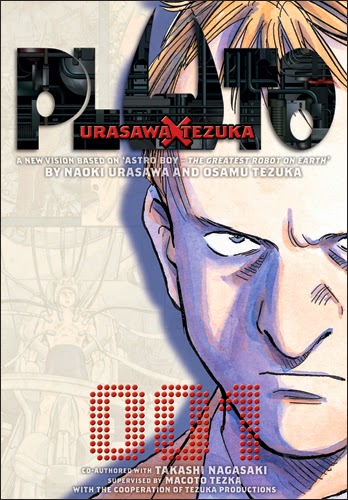
Pluto by Naoki Urasawa (the entire manga series): In a world where man and robots coexist, the powerful Swiss robot Mont Blanc has been destroyed. Elsewhere a key figure in a robot rights group is murdered. The two incidents appear to be unrelated…except for one very conspicuous clue – the bodies of both victims have been fashioned into some sort of bizarre collage complete with makeshift horns placed by the victims’ heads. Interpol assigns robot detective Gesicht to this most strange and complex case – and he eventually discovers that he too, as one of the seven great robots of the world, is one of the targets.

This series of books is on the Science and Technology list, and it’s one that I didn’t read. It sounds really fantastic though, and I appreciate how an entire manga series is on the OBCB list — not only does it showcase how graphic novels can be “real reading,” but it shows that even a format that many consider to be “lesser” than more “prestigious” graphic novels are worthwhile, thought-provoking, important reads. 

Little Fish: A Memoir From a Different Kind of Year by Ramsey Beyer: Told through real-life journals, collages, lists, and drawings, this coming-of-age story illustrates the transformation of an 18-year-old girl from a small-town teenager into an independent city-dwelling college student. Written in an autobiographical style with beautiful artwork, Little Fish shows the challenges of being a young person facing the world on her own for the very first time and the unease–as well as excitement–that comes along with that challenge. 

Beyer’s memoir is maybe less of a graphic novel than the others on this list, but I’m including it because the style will have appeal to those readers who love the graphic format. This is sort of collage/scrapbook style storytelling, with art, lists, and images sprinkled throughout the story of Beyer’s first year at art school. What’s great about this book and why it fits so well on the list is that it’s the first-hand experience of the first year of being away at school. There are highs and there are lows, there are expectations met and failed, and there is a lot of musing about relationships past and present. It’s honest and heartfelt, and it’s the kind of realistic portrayal I wish I’d read before I went to college. It would have definitely made me feel less alone or weird in some of the less-than-pleasant feelings I had when I went to college and away from home. 

For the previous roundups of titles on the Outstanding Books for the College Bound list, you can find them on the topics of music and musicality, religion and spirituality, girls across borders, and football and football culture. 

Filed Under: Adult, Graphic Novels, Non-Fiction, outstanding books for the college bound, Uncategorized, Young Adult

New This Spring: Two Snappy Reviews

April 9, 2014 |

The Falconer by Elizabeth May
May brings us
savage, murderous faeries in her debut featuring a teenage girl with the
unique ability to hunt them down. A faery killed Aileana’s mother and
since then, she’s vowed to exact revenge upon it – as well as any other
faeries she can get her hands on, with the exception of a sympathetic
faery who trains her and a tiny pixie who keeps her company and mends
her clothing. The story, set in 1844, is notable for its exploration of
faery lore, which is (according to an author note) based on actual
Scottish mythology. May’s faeries are sometimes beautiful, sometimes
hideous, but always deadly, hearkening back to a time when all
supernatural beings were referred to as faeries by the Scots.

There’s
some romantic tension between Aileana and her trainer, the faery
Kiaran, who sometimes seems human and at other times is definitely,
absolutely not. It kind of works, if you can get past the fact that he’s
thousands of years old and she is a teenager. The writing is mostly
good, though not uniformly so. May is able to communicate quite clearly
how devastated Aileana is by her mother’s death. In many ways, this is a
very dark book, full of violence and despair. I wish the plot had been a
bit more complex – it mostly involves Aileana hunting faeries, then
strategizing with Kiaran once they learn that a whole horde of the most
dangerous kinds of faeries are about to be released upon the world. The
pseudo-twist ending may be the most interesting part of the book – too
bad we couldn’t get there sooner. Nevertheless, this should please fans of fairies and books heavy on action.

Sekret by Lindsay Smith
I was intrigued by the premise of this debut, which is set in Soviet Russia in 1963 and involves teenage psychics recruited (read: blackmailed) by the KGB into serving as spies. Protagonist Yulia is one of these spies. The KGB is threatening her family and coercing her into sabotaging the American space program.

Much of the book focuses on Yulia’s training as she struggles to discover who among the other recruits she can trust (none of them). She learns how to put up mental walls to fend off psychic attacks as well as how best to attack others, gleaning the information her captors require. Above all, she wants to escape and rescue her family.

What this book does well is portray Yulia’s internal struggles – her mind under attack from others, her desperation over her situation, her struggle to hone her skills. I wished the plot were a bit more exciting, though. For a story about spies, it’s pretty slow and the missions they’re sent on aren’t terribly exciting. I have trouble remembering much of them at all. As with The Falconer, there’s some interesting stuff right at the end, but up to that point, there’s just not a lot going on. But psychics and spies are both trendy now, so I expect a book featuring them working for the KGB will go over well.

Review copies provided by the publishers. The Falconer will be available May 6. Sekret is available now.

Filed Under: Reviews, Uncategorized, Young Adult

Salvage by Alexandra Duncan

April 8, 2014 |

I’ve written before about how I’m tired of young adult science fiction that is only capable of imagining a future where women are treated in awful ways (usually explicit or de facto sexual slavery). Often, these sorts of hypothetical societies seem done more for shock value than to serve the story and its characters, and they frequently do not take a hard look at where certain Earth societies are now and postulate a logical future for them. So you can imagine my trepidation going into Salvage by Alexandra Duncan.

The story begins on a space ship where grown men take multiple teenage girls as wives. Women and girls are not allowed to set foot on Earth (though men are), and the culture’s mythology prevents them from doing something as basic as singing, much less making repairs to the ship or anything else besides child-rearing.

Ava was born into this society, aboard a trading ship called the Parastrata. She is sixteen and has been told she is to become a wife to a man aboard the Aether. When it appears that Luck, the captain’s son and her friend and sweetheart of sorts, is to be that man, she is overjoyed. But Ava and Luck make a terrible mistake based on faulty information, and Ava finds herself on the run from her family and the crews of both the Parastrata and the Aether.

What I’ve mentioned above is actually a fairly small portion of the book. Most of Ava’s story takes place on Earth. She initially escapes to the Gyre, a continent-sized trash heap in the middle of the Pacific Ocean. She’s taken in by a scarred (physically and metaphorically) but kind woman and her pre-teen daughter, who teach Ava how to fly a ship. Afterward, Ava finds herself in Mumbai, seeking her mother’s sister. These two settings are wildly different (one completely fabricated), but equally well-realized.

This is a slower-paced book, not as chock-full of action as, say, Beth Revis’ Across the Universe or Amy Kathleen Ryan’s Glow, which it’s been compared to (though it still reads very quickly). Duncan takes time to immerse the reader in each place she creates, whether that place is space, the Pacific Ocean, or India. Everything is told through Ava’s eyes, so the wonder and mystery and strangeness of all these settings is made very clear. That’s one thing I really loved about this book: it highlights just how overwhelming it is to find yourself in a place where no one understands you. And the place where Ava is understood, at least to a degree – the Parastrata – does make sense in the context of the story. Duncan’s writing never makes what happens aboard the ship seem salacious. The fact that the ships are so isolated from Earth, free of any regulation but their own, in a harsh environment, does make it more likely that they’d develop a society that adheres to a very rigid set of rules that benefits those already in power. This is addressed in more depth near the end of the book.

It’s clear that future Earth is wildly different from present-day Earth, but we don’t get an infodump that explains how it got that way. Instead, we discover on our own. Duncan lets the reader infer from what Ava sees: the trash in the middle of the ocean, the difference in living conditions between different classes of people in Mumbai, and so on. When done right, world-building is a discovery, and I feel like Duncan nailed it.

There’s a lot that Duncan packs into her novel, theme-wise: the meaning of family, the ethics of objectively studying another human culture, class privilege, gender and sexuality. Furthermore, the cast is multi-racial and multi-cultural, so important and so rare in mainstream YA SF. And if that weren’t enough to entice you to pick this one up, Ava is also good at math and mechanical repairs – in fact, she taught herself how to do sums! I’ll be the first to say I dislike math, but it is so very nice to read about a girl who loves it and excels at it.

Readers who aren’t big fans of science fiction may initially shy away from Ava’s narration, as her speech patterns are a bit odd. She uses some words in different ways than we do; it takes some getting used to. I really appreciate when an author does this. Again, there’s no explanation for the oddness in speech – we figure out what it means along the way. It’s just another way Duncan brings us into Ava’s world.

YA books set in space are trendy right now. This one is more thoughtful and less plot-driven than the others, more like a classic coming-of-age story, different but no worse than thrillers like Glow or Across the Universe. Salvage is a good book for more patient teens who will appreciate reading about a sheltered girl who comes into her own as a young woman in a wild, sometimes-scary, often-beautiful world.

Review copy provided by my librarian book twin and Angie (@misskubelik). Salvage is available now.

Filed Under: Reviews, Science Fiction, Uncategorized, Young Adult

Revisiting YA Verse Novels: A 2014 Guide to the Format

April 7, 2014 |

April is poetry month, and while we didn’t write a lengthy genre guide to verse novels that month to celebrate, we did write one in May. If you’re curious about the format of YA novels in verse, that should get you set on what it is, why it’s so appealing, and it offers a pretty extensive reading list to titles published in the last few years.

Since I didn’t want to replicate work and write another guide to the genre, I thought it would be worthwhile to talk about the books in 2014 that are verse novels. Some of the titles are out already, while others will be publishing before the end of the year. This list is for titles published by traditional publishers, and it’s very possible that I’ll overlook some, so feel free to jump in with additional titles in the comments. A couple of titles below could easily be middle grade, as they fall into that strange category of being good for readers from age 10 to 14. I’m including them anyway. 

All descriptions are from WorldCat, and I’ve included publication dates for titles not yet available. Of course, if you’re a fanatic of verse novels, make sure you check out Verse Novels and that you stay tuned for the third annual verse novels series over at Clear Eyes, Full Shelves, which will take place the last week of April. 

Of note: a nice percentage of these titles are diverse. 

And We Stay by Jenny Hubbard: Sent to an Amherst, Massachusetts, boarding school after her ex-boyfriend shoots himself, seventeen-year-old Emily expresses herself through poetry as she relives their relationship, copes with her guilt, and begins to heal. **This book is partially in verse and partially in traditional prose. 

The Sound of Letting Go by Stasia Ward Kehoe: At seventeen, Daisy feels imprisoned by her brother Steven’s autism and its effects and her only escape is through her trumpet into the world of jazz, but when her parents decide to send Steven to an institution she is not ready to let him go.


Kiss of Broken Glass by Madeline Kuderick (September 9): After she’s caught in the school bathroom cutting herself with the blade from a pencil sharpener, fifteen-year-old Kenna is put under mandatory psychiatric watch. She has seventy-two hours to face her addiction, deal with rejection, and find a shred of hope. Description via Goodreads. 

Two Girls Staring At The Ceiling by Lucy Frank (August 5): Chess, the narrator, is sick, but with what exactly, she isn’t sure. And to make matters worse, she must share a hospital room with Shannon, her polar opposite. Where Chess is polite, Shannon is rude. Where Chess tolerates pain silently, Shannon screams bloody murder. Where Chess seems to be getting slowly better, Shannon seems to be getting worse. How these teenagers become friends, helping each other come to terms with their illness, makes for a dramatic and deeply moving read. Description via Goodreads. 

A Time To Dance by Padma Venkatraman (May 1): In India, a girl who excels at Bharatanatyam dance refuses to give up after losing a leg in an accident.

Rumble by Ellen Hopkins (August 26): Eighteen-year-old Matt’s atheism is tested when, after a horrific accident of his own making that plunges him into a dark, quiet place, he hears a voice that calls everything he has ever disbelieved into question.

Like Water on Stone by Dana Walrath (November 11): Inspired by a true story, this relates the tale of siblings Sosi, Shahen, and Mariam who survive the Armenian genocide of 1915 by escaping from Turkey alone over the mountains.

Silver People: Voices From the Panama Canal by Margarita Engle: Fourteen-year-old Mateo and other Caribbean islanders face discrimination, segregation, and harsh working conditions when American recruiters lure them to the Panamanian rain forest in 1906 to build the great canal.

Dust of Eden by Mariko Nagai: Thirteen-year-old Mina Tagawa and her Japanese-American family are forced to evacuate their Seattle home and are relocated to an internment camp in Idaho, where they live for three years. 

Caminar by Skila Brown: Carlos knows that when the soldiers arrive with warnings about the Communist rebels, it is time to be a man and defend the village, keep everyone safe. But Mama tells him not yet — he’s still her quiet moonfaced boy. The soldiers laugh at the villagers, and before they move on, a neighbor is found dangling from a tree, a sign on his neck: Communist. Mama tells Carlos to run and hide, then try to find her … Numb and alone, he must join a band of guerillas as they trek to the top of the mountain where Carlos’s abuela lives. Will he be in time, and brave enough, to warn them about the soldiers? What will he do then? A novel in verse inspired by actual events during Guatemala’s civil war, Caminar is the moving story of a boy who loses nearly everything before discovering who he really is.

Poisoned Apples by Christina Heppermann (September 23): Christine Heppermann’s powerful collection of free verse poems explore how girls are taught to think about themselves, their bodies, their friends–as consumers, as objects, as competitors. Based on classic fairy tale characters and fairy tale tropes, the poems range from contemporary retellings to first person accounts set within the original stories. From Snow White cottage and Rapunzel’s tower to health class and the prom, these poems are a moving depiction of young women, society, and our expectations. Poisoned Apples is a dark, clever, witty, beautiful, and important book for teenage girls, their sisters, their mothers, and their best friends. **While not a traditional novel in verse, I’m including this title since verse lovers will definitely be interested. 

Filed Under: book lists, Uncategorized, Verse, Young Adult

Twitterview: Brandy Colbert (POINTE)

April 3, 2014 |

Yesterday, we had a review of Brandy Colbert’s knockout debut Pointe. Today, we have a Twitterview with her, asking the tough questions about Pointe, her writing process, as well as the books and music that inspire her. This is our first Twitterview of the new year, and it’s a good one.


In addition, we’re giving away two finished copies of Pointe. Form is at the bottom of the interview, and the contest is open to US and Canadian residents only.


I’m so excited to share this conversation, so without further ado, here’s Brandy.

Pitch Pointe in 140 characters.

A gifted dancer’s life unravels when her childhood best friend returns after four years in captivity—and she has ties to the abduction.
What inspired Pointe?

A lifelong love of dance and an obsession with long-term kidnapping stories, especially the one portrayed in I Know My First Name Is Steven.

How would you describe Theo, your main character?

Determined. Foolhardy. Passionate. Competitive. 


Theo is a POC in a very white world (in setting and sport). Talk about that.

Theo is very aware that she sticks out in her world, but she refuses to let her race define her, in both her life and desired profession.

Do you have more to say about that?  

I do! POINTE is the third book I’ve written about a teenage black girl, but it’s the first in which her race was not the focal point or even a subplot of the story. As someone who grew up black in a predominantly white town in southwest Missouri, I wanted to write a character who dealt with some of the day-to-day issues and obstacles I’d experienced without that being the point of the book. I was very involved in academics and extracurricular activities as a child and teen, and although it was a little tough almost always being the only black person in the room, or being the first black person to, for instance, join my high school’s dance team, I think those years were instrumental in shaping the person I am today. Overall, I had a great time in high school and tried to make the best of it. If people were going to notice me for being different anyway, I wanted them to especially notice me for my accomplishments. I believe Theo has a similar attitude.

There’s romance in this book but it’s the friendships that stand out to me. Tell me about Theo and Ruthie’s friendship.

They’re lifelong friends from ballet and are competitive, but also have a mutual respect and trust that extends to life beyond the studio.

And how about Theo and Donovan’s friendship?

Complicated. They’re essentially strangers now, but also bonded for life, because and in spite of what happened when they were thirteen.

Was there a particular scene in the book you most enjoyed writing?

Theo + Hosea in the gazebo. They don’t really know each other and are both very  private, but they open up to talk honestly about their art.


What about a scene that gave you the most trouble writing? 

Scenes at the abandoned park and convenience store. Dance scenes can be tough; you want to show authority + beauty without getting jargon-y.

Who is your ideal reader for Pointe? 

Truly, everyone. But I love the idea of young black girls who haven’t seen themselves represented this way in YA fiction connecting to it.

Is there anything you want readers to walk away with? 

Hmm. I’d be happy knowing people think about the story at all after they finish the book.

Pointe is your debut novel. What’s been the most exciting part of your debut year so far?

That people who aren’t related to me care about this little idea that lived in my head and on my computer for years. It’s so very surreal.

What’s been the most surprising part of your debut year? 

Emotions, everywhere! About everything! Also, time management is pretty much nonexistent these days.

If you had to give your book a “____ meets _____” pitch, what two (or three! or four!) books/films/shows would Pointe be a meeting of?

My editor has described it as “Black Swan” meets “Speak.” I’m terrible at mash-ups and it’s super flattering, so I’ll go with that.

Outside of writing, what do you do with your free time? 

I joke about being a hermit and it’s maybe 40% true. I read a lot. Obsess over TV. Hang with friends who trick me into things like hiking.


Who or what do you write for?

Myself, mostly. Writing is very therapeutic for me, and my work is at its best when I write the type of story I would love to read.

What was your most influential read as a teenager?

How Do You Lose Those Ninth-Grade Blues? It was already dated when I first read it, but DeClements’ books really speak to me. 
Who are your top three writing influences?

ZZ Packer, Courtney Summers, Barthe DeClements
Who do you believe is breaking ground in YA right now?

Stephanie Kuehn, Corey Ann Haydu, Carrie Mesrobian, Blythe Woolston, Steve Brezenoff

Can you share three of your all-time, would-recommend-to-anyone favorite books?

The Particular Sadness of Lemon Cake by Aimee Bender, A Little Princess by Frances Hodgson Burnett, Hold Still by Nina LaCour
What’s the best writing advice you ever received?

Be an honest writer. I found my voice once I stopped worrying what people would think of me for writing dark books about complicated topics.

What’s your best writing advice to give?

If people say there’s no room on the shelves for the books you write, keep at it until someone makes room for you. Don’t give up.

What is your writing routine?

I am completely without routine, but I’ve always done my best writing late at night, and when I have large chunks of time to devote to it.

What gets you jazzed to write?

I’m inspired by good writing and storytelling, so: discovering new books/TV/film, my critique partners’ work, rereading old favorites.

Do you have a writing soundtrack? Care to share a bit?

I love music, but don’t write to it! In the rare instance I do, I tend to go with groups like Zero 7, Daft Punk, and Thievery Corporation.

What’s next for you?

More gritty YA contemp about black girls. I’m working on two projects that I’m unbelievably excited about, but they’re under wraps for now.

Favorite ice cream?

Only the tough questions! Tie between Ben & Jerry’s AmeriCone Dream, Häagen-Dazs Dulche de Leche, and Trader Joe’s Golden Caramel Swirl.

Would you like the chance to win Pointe? We’re giving away two finished copies. Fill out the form below. We’ll pull winners at the end of the month.

Filed Under: Author Interview, contemporary ya fiction, debut authors, multicultural, Uncategorized, Young Adult

  • « Previous Page
  • 1
  • …
  • 102
  • 103
  • 104
  • 105
  • 106
  • …
  • 237
  • Next Page »
  • Facebook
  • Instagram
  • Pinterest
  • Twitter

Search

Archives

We dig the CYBILS

STACKED has participated in the annual CYBILS awards since 2009. Click the image to learn more.

© Copyright 2015 STACKED · All Rights Reserved · Site Designed by Designer Blogs