• STACKED
  • About Us
  • Categories
    • Audiobooks
    • Book Lists
      • Debut YA Novels
      • Get Genrefied
      • On The Radar
    • Cover Designs
      • Cover Doubles
      • Cover Redesigns
      • Cover Trends
    • Feminism
      • Feminism For The Real World Anthology
      • Size Acceptance
    • In The Library
      • Challenges & Censorship
      • Collection Development
      • Discussion and Resource Guides
      • Readers Advisory
    • Professional Development
      • Book Awards
      • Conferences
    • The Publishing World
      • Data & Stats
    • Reading Life and Habits
    • Romance
    • Young Adult
  • Reviews + Features
    • About The Girls Series
    • Author Interviews
    • Contemporary YA Series
      • Contemporary Week 2012
      • Contemporary Week 2013
      • Contemporary Week 2014
    • Guest Posts
    • Link Round-Ups
      • Book Riot
    • Readers Advisory Week
    • Reviews
      • Adult
      • Audiobooks
      • Graphic Novels
      • Non-Fiction
      • Picture Books
      • YA Fiction
    • So You Want to Read YA Series
  • Review Policy

STACKED

books

  • STACKED
  • About Us
  • Categories
    • Audiobooks
    • Book Lists
      • Debut YA Novels
      • Get Genrefied
      • On The Radar
    • Cover Designs
      • Cover Doubles
      • Cover Redesigns
      • Cover Trends
    • Feminism
      • Feminism For The Real World Anthology
      • Size Acceptance
    • In The Library
      • Challenges & Censorship
      • Collection Development
      • Discussion and Resource Guides
      • Readers Advisory
    • Professional Development
      • Book Awards
      • Conferences
    • The Publishing World
      • Data & Stats
    • Reading Life and Habits
    • Romance
    • Young Adult
  • Reviews + Features
    • About The Girls Series
    • Author Interviews
    • Contemporary YA Series
      • Contemporary Week 2012
      • Contemporary Week 2013
      • Contemporary Week 2014
    • Guest Posts
    • Link Round-Ups
      • Book Riot
    • Readers Advisory Week
    • Reviews
      • Adult
      • Audiobooks
      • Graphic Novels
      • Non-Fiction
      • Picture Books
      • YA Fiction
    • So You Want to Read YA Series
  • Review Policy

Guest Post: On Writing Realistic, Flawed Parents in YA by Bryan Bliss (& giveaway of NO PARKING AT THE END TIMES)

February 26, 2015 |

I’m really excited to share this guest post from debut author Bryan Bliss today. Bliss is the author of No Parking at the End Times, which I wrote about earlier this week. When I finished the book, I couldn’t stop thinking about the portrayal of the parents in this story, and I asked if he’d be interested in talking a bit more about parents in YA fiction. It’s a topic that comes up in terms of parents being bad pretty frequently, but rarely do we look at parental intentions in YA fiction — what if parents aren’t bad but don’t always come off in the best light, despite doing what they think is right?

Enjoy this thoughtful post and at the end, you have the chance to win a copy of Bliss’s novel.

Bryan Bliss is the author of No Parking at the End Times. He has worked with teenagers for more than ten years and holds an MFA from Seattle Pacific University. This is his first novel. You can find him on Twitter @brainbliss. 

When people read my debut novel, No Parking at the End Times, the first thing I hear is some combination of: Those awful parents! and Somebody call Child Protective Services! As they make mistake after mistake (most of which would be unforgivable on their own), and continue risking everything because of the misguided prophecy of a radio preacher… let’s just say that readers don’t exactly empathize with them.
And I get it, I really do. Facebook alone gives me enough reason to seek out blood pressure medication. Stories about parents who take their daughters – and its always the daughters – to purity balls are guaranteed to get my blood going. Yet, whenever somebody gets in a huff about the parents in my novel, I pause and immediately think: Yeah, but…
From the very beginning, I wanted No Parking to be a story about a girl losing faith in her parents. Granted, it would happen on a bigger scale than most of us will ever face. But that rush of understanding – when and how a teenager transitions to the reality that her parents are not perfect – is so real, so painful, it fueled every moment of the book. But it left me with a challenging quandary: what do you do with parents who – arguably – have ruined the lives of their children? How do you write about the people you’d usually mock on Facebook?
The problem, of course, is that many parents in young adult fiction are not flawed. Sure, they have cute issues – you know the type. Oh Dad, you’re so goofy! Mom! Stop trying to buy me all these clothes… I don’t want to wear a dress! These central-casting problems can easily be spun as authentic in the pages of a novel. They become subplots, little moments that challenge the main character in-between bigger plot points.
And that’s fine. I’m not going to talk badly about these characters. 
But I want more. A lot more. 
I want to see the perfect mom lose her shit at the school assembly. I want to see the dad who’s struggling to make rent accidentally – and regrettably – snap at his kids. I want parents who, in the pages of our novels, make real mistakes that actively and deeply affect the lives of their children. If we’re going to claim that young adult literature has depth – which it certainly does – we need to give our parents scars. We need real representations of the adults in most teenagers’ lives. We need them to be fallible. And we need to understand why they are that way.
A case could be made that there are already plenty of flawed parents in young adult literature. Richie, from Rainbow Rowell’s Eleanor and Park immediately comes to mind. Is there a more despised character in YA? For me, no. But is Richie flawed or is he a villain? For some, the line between the two is blurred – and not to our benefit. I struggle to find the moment when Richie is ever supportive, when he shows me that he is a loving adult for the children and teenagers in that story. 
And that’s why the vitriol for the parents in No Parking is so confounding. In their own confused way, they are trying to do the right thing for their kids. Their belief system tells them that – if they sell everything, if they really believe – they will be rewarded. So when the End doesn’t come – when a desperate family has its only answer taken away – what do they do? 
They stay. Of course they stay. This is their answer. What happens if they leave and then the Rapture happens? What then? No matter what anybody says, I will argue this point until I am out of breath. They stay.
Because they are good parents. They are confused parents. They are flawed parents. In my mind, these three things are inextricable and necessary. To use the parents in my novel simply as a way to mock their belief – without realizing how much pain they’re in, how worried they really are – is not only a mistake for the story, but also for the readers.
If we’re going to create believable adults in young adult literature, we need to be brave enough to not only write unlikable and flawed parents – but to write them with the same care and compassion we bring to Nuclear Mom and Dad.  If we don’t, we’re in danger of teaching teenagers that adulthood means finally having all of our shit worked out.

But I’m still not there. Are you?

***

Want to win a copy of Bliss’s No Parking at the End Times? I’ll give away two finished copies sometime mid-March. As long as you can get books from the Book Depository, you can enter!

Filed Under: bryan bliss, debut authors, Guest Post, parents, Uncategorized, young adult fiction

No Parking at the End Times by Bryan Bliss

February 23, 2015 |

When Abigail’s father loses his job, things in her household change. Her father becomes fascinated with Brother John, and soon, he’s convinced her mother to follow the word of Brother John as well. He promises a better afterlife, and it’s one that’s coming soon.

It takes little time for Abigail’s father to begin selling their earthly possessions. Despite not being on board, Abigail and her twin brother Aaron are pulled into this world, forced to climb into the traveling van and leave their home town in North Carolina for San Francisco, where Brother John would be waiting with the rest of his followers for the rapture.

But when they arrive in San Francisco, homeless and mostly possession-less, the rapture doesn’t come. And rather than turn back or give up, Abigail and Aaron’s father decides they have to stick it out. They have to have faith that Brother John knows what’s happening.

They have to have faith that God has a reason for things not to come to an end, even on the date Brother John believed it would happen.

No Parking at the End Times is Bryan Bliss’s debut novel, and it’s a knock out. Where many stories of the rapture in YA happen prior to it, this takes place after the failed event. But this isn’t really a story about the rapture. It’s much more a story about family and togetherness, with a unique take on homelessness.

Throughout the story, we’re shown an angry, frustrated character in Aaron. As much as Abigail tries to break through to him and tries to get him to talk with her, he won’t. Instead, he’s sneaking out of the van at night. It’s not until Abigail threatens to follow him that she finds out his nightly trips are his way of making friends and connections in San Francisco; he’s become friends with a group of homeless teens.

Despite finding a sort of community, being in San Francisco is the last thing Aaron wants. He’s eager to get out, and he’s upfront with Abigail about how they need to figure out how to get away. When they make a plan that seems achievable and make strides toward getting out, though, he becomes unable to follow through because of some of the people with whom he’d been associating at night.

From the start, neither Abigail nor Aaron are on board with their father and mother’s devotion to Brother John. As readers, we’re also exceptionally frustrated — why would a father do this to his family? He’s sold their lives away, and he willingly sacrifices security and safety in the name of faith in this system. He hands over money, and he at times cheats the system. Mother follows along, mostly, her voice and story a far smaller part of the story than the father’s until the end.

But there are cracks.

As much as we’re left to be angry at both mom and dad for how selfish and self-serving they’re being, we’re also allowed to see they truly believe that having faith — that believing good things will happen — will get them through this tough situation. They’ve found places to get free meals, and they’ve learned where they can park at night to keep their family safe. They continue attending church services, as well as offering money to Brother John, believing with their whole hearts that this is the right thing to do. That it is what will solve their problems and make a better life for their children. Though they want their kids to follow Brother John and his word, they don’t force them to attend services or counseling with him.

It’s blind faith, of course, and it’s the kind of faith that overruns practicality and sufficiency. But it’s done out of utter love for their children, even if their children are the ones who suffer the consequences of these decisions.

Bliss does an excellent job in his portrayal of homelessness. In multiple instances throughout the story, Abigail has a painful realization that what she believed homelessness looked like isn’t always what homelessness is. The people Aaron hangs out with are homeless, and even though they fit what she thought homelessness would look like, she’s surprised to see how human and how relatable and likable some of those people are. When Abigail is confronted with the reality that, despite her internal protests, she and her family are homeless, too, it’s tough for her to swallow. She isn’t like the them of her imagined state of homeless people. Her family didn’t choose to become homeless. And yet, this is still homelessness and it’s still the situation her family is in. More, she comes to the realization that adults can be wrong and make poor choices that do indeed change the lives of those for whom they’re entrusted to care. It’s because of her parents choosing to give all of their money to Brother John that she has a limited selection of things to wear and can’t get her clothing dirty. It’s because of her parents selling everything for this trip to San Francisco that they’re brushing their teeth in public restrooms.

Abigail’s voice in this book is what stands out most — she is straightforward in how she feels, even if she doesn’t always act upon her intuitions when she thinks she should. She’s full of love and full of want, despite the set backs in her life and despite the fact she’s learning that her situation is worse than she thought. It’s in the moments when reality hits perception that readers see how desperate her and her family’s situation really is.

No Parking at the End Times is a respectful story. This isn’t about bashing faith or God or belief in any way, despite the premise being about parents who are devoted to a religious cult-like leader. It’s an entire story about the limits of faith. Have it, use it, believe in it, but don’t let it be the only currency in your life.

The ending of this book is a little tidy, but it doesn’t feel undeserved. In fact, it’s that final chapter, where Abigail has to face God and faith again where we see that this isn’t a story that decries religion but instead, seeks to talk about how it’s a deeply personal and sometimes extremely challenging experience.

This is a tightly-written, engaging read and would make for an excellent next read for those who love Sara Zarr, especially Once Was Lost. Pass this along, too, to those readers who loved Blake Nelson’s The Prince of Venice Beach — the depictions of homelessness are worth looking at together — and/or Melissa Walker’s Small Town Sinners. Bliss is an author to keep an eye on, and I’m really looking forward to seeing what a sophomore novel will look like, after this powerful debut.

Review copy received from the publisher. No Parking at the End Times publishes tomorrow, February 24. 

Filed Under: debut authors, debut novels, review, Reviews, Uncategorized, Young Adult, young adult fiction

February Debut YA Novels

February 19, 2015 |

For what’s usually a fairly quiet month in publishing, February is heavy on debut YA titles this year. Like always, this round up includes debut novels with “debut” in its purest definition. These are first-time books by first-time authors. I’m not including books by authors who are using or have used a pseudonym in the past or those who have written in other categories (adult, middle grade, etc.) in the past. Where we’ve reviewed books, I’ve included links.

All descriptions are from WorldCat, unless otherwise noted. If I’m missing any debuts out in February from traditional publishers, let me know in the comments!  

One of the Guys by Lisa Aldin: Tomboy to the core, Toni Valentine understands guys. She’ll take horror movies, monster hunts and burping contests over manicures. So Toni is horrified when she’s sent to the Winston Academy for Girls, where she has to wear a skirt and learn to be a “lady” while the guys move on without her. Then Toni meets Emma Elizabeth, a girl at school with boy troubles, and she volunteers one of her friends as a pretend date. Word spreads of Toni’s connections with boys, and she discovers that her new wealthy female classmates will pay big money for fake dates. Looking for a way to connect her old best friends with her new life at school, Toni and Emma start up Toni Valentine’s Rent-A-Gent Service. But the business meets a scandal when Toni falls for one of her friends–the same guy who happens to be the most sought-after date. With everything she’s built on the line, Toni has to decide if she wants to save the business and her old life, or let go of being one of the guys for a chance at love.

My Heart and Other Black Holes by Jasmine Warga: Seventeen-year-old Aysel’s hobby–planning her own death–take a new path when she meets a boy who has similar plan of his own.

When Reason Breaks by Cindy L. Rodriguez: Elizabeth Davis and Emily Delgado seem to have little in common except Ms. Diaz’s English class and the solace they find in the words of Emily Dickinson, but both are struggling to cope with monumental secrets and tumultuous emotions that will lead one to attempt suicide.

The Distance Between Lost and Found by Kathryn Holmes: Sophomore Hallie Calhoun, her former friend Jonah, and new friend Rachel leave a church youth group hike in the Great Smoky Mountains and become lost for five days, struggling to survive as Hallie finally speaks about the incident that made her a social pariah and Jonah admits why it hurt him so much.

Vendetta by Catherine Doyle: When five brothers move into the abandoned mansion next door, Sophie Gracewell’s life changes forever. Irresistibly drawn to bad boy Nic Falcone, Sophie finds herself falling into an underworld governed by powerful families. When Sophie’s own family skeletons come to life, she must choose between two warring dynasties–the one she was born into, and the one she is falling in love with.

Scripted by Maya Rock: Nettie Starling has spent all her life on the set of a reality show, but as her friends mysteriously get cut, she learns that her seemingly-perfect world hides some dangerous secrets. 

Dove Arising by Karen Bao: On a lunar colony, fifteen-year-old Phaet Theta does the unthinkable and joins the Militia when her mother is imprisoned by the Moon’s oppressive government.

Shutter by Courtney Alameda: Seventeen-year-old Micheline Helsing is a tetrachromat, able to see ghosts in color and capture them on film, but when a routine hunt goes awry, Micheline’s infected with a curse known as a soulchain and if she’s unable to exorcise the entity in seven days, she’ll be destroyed, body and soul.

When My Heart Was Wicked by Tricia Stirling: After her father dies, leaving sixteen-year-old Lacy with her much-loved stepmother, Lacy’s birth mother suddenly shows up wanting Lacy back–and she will stop at nothing, not even dark magic, to control her daughter and draw her into her own twisted life.

No Parking At The End Times by Bryan Bliss: Abigail’s parents, believing the end of the world is near, sell their house, give the money to an end-of-times preacher, and drive from North Carolina to San Francisco where they remain homeless and destitute, as Abigail fights to keep her parents, her twin brother, and herself united against all odds.

The Sin-Eater’s Daughter by Melinda Salisbury: For four years sixteen-year-old Twylla has lived in the castle of Lormere, the goddess-embodied, whose touch can poison and kill, and hence the Queen’s executioner–but when Prince Merek, her betrothed, who is immune to her touch returns to the kingdom she finds herself caught up in palace intrigues, unsure if she can trust him or the bodyguard who claims to love her.

A Wicked Thing by Rhiannon Thomas: One hundred years after falling asleep, Aurora wakes to the kiss of a handsome prince and a kingdom that has dreamed of her return, but her happily-ever-after seems unlikely as she faces grief over the loss of everything she knew and a cruel new king.

The Boy Next Door by Katie Van Ark: Neighbors and figure skating partners since preschool, Gabe and Maddy tell, in their separate voices, of changes on and off the ice when they are assigned a new, romantic program, raising Maddy’s hopes of her love being returned and Gabe’s fears that romance will break up their partnership.

Filed Under: debut authors, debut novels, debuts 2015, Uncategorized, Young Adult, young adult fiction

Old Books, New Titles: Cynthia Voigt’s (Tales of the) Kingdom Series

February 18, 2015 |

One of my most favorite books from when I was a child is On Fortune’s Wheel by Cynthia Voigt, the second book in a loosely-connected non-magical fantasy series called the Kingdom. The other books in the series are Jackaroo, Wings of a Falcon, and Elske. While they’re all fantastic, On Fortune’s Wheel occupies a special place in my heart – it was the first I read and it fundamentally changed my idea of what a book could be. It was set in a made-up land, but it didn’t have any magic. It dealt with slavery in a way that seemed very frank to me at the time. I learned what an amanuensis was and how to pronounce it. It made me see personal identity in new ways (I read certain sections of the book centering around this idea so often I have them committed to memory). The protagonist had sex (the fade-to-black kind, but it was there). And it ended with the girl deciding what was best for her, what she really wanted, and then doing it. And she was happy. I was in middle school when I read it, and I think these books are just right for that age group.

Voigt has always garnered much (deserved) recognition for the Tillerman cycle (Homecoming won a National Book Honor, Dicey’s Song the Newbery Medal, and A Solitary Blue a Newbery Honor), and those books tend to eclipse a lot of her other work. I always wished that her fantasy books were discussed a bit more, which is why I was so pleased to see that Atheneum is re-releasing the Kingdom books with a new look and new titles in May of this year.

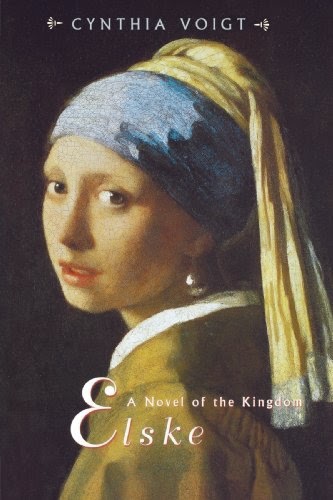
With the re-release, the titles have been homogenized and simplified greatly. Jackaroo is now The Tale of Gwyn, On Fortune’s Wheel is The Tale of Birle, Wings of a Falcon is The Tale of Oriel, and Elske is The Tale of Elske. The entire series has been renamed The Tales of the Kingdom to match. I’m of two minds about the title changes. On the one hand, I like that they match each other, that it’s immediately apparent they belong in the same series. I also like the legend-like feel they give to the stories. This works especially well for Jackaroo, which is about a Robin Hood type of figure and the legends told about him. It also works well for the series as a whole: the books are loosely connected not by re-use of characters, but by stories – legends – passed down about these characters generations later.

On the other hand, the titles are a bit boring. Voigt’s fantasy character names aren’t terribly original (they’re kind of cliche, actually, but I forgive her) and so I don’t think they feature all that well in the titles. I think the original titles are more interesting and – with the exception of Elske – better reflect the meaning of the stories themselves.

I actually really loved some of the older covers for the books. At one point, they featured Vermeer paintings, which I found terribly romantic. Vermeer is one of my favorite painters and a big reason is because he is forever connected to these books in my mind. Here are three of the Vermeer covers (I don’t think Wings of a Falcon ever had one):

The 2015 releases aren’t the first time the covers have been redesigned. Simon Pulse published some paperbacks in 2003 that still look pretty modern to me, in that a lot of current fantasy novels feature an object central to the story on the cover. Again, Wings of a Falcon seems to have been left out.

I like the new designs, pictured at the top of this post, though I think they’re pretty generic (much like the titles). They skew a little more middle-grade for me, probably because they’re illustrated. On Edelweiss these books are listed as YA – grades 7 and up. When I read them, the books were located in the J section (though to be fair, YA sections weren’t really around much then), and I’d say the writing is more of a middle school YA than a high school YA. The cover for the Tale of Elske is the most interesting by far. Frustratingly, Edelweiss doesn’t have the cover for the Tale of Birle up yet. Don’t they realize that’s the one I’m most interested in?

Have you read these books? What’s your take on the new titles and new designs?

Filed Under: cover design, Cover Redesigns, Fantasy, Uncategorized, Young Adult, young adult fiction

Cover Reveal: The Death and Life of Zebulon Finch, Volume 1: At the Edge of Empire by Daniel Kraus

January 22, 2015 |

We have never done a cover reveal before on Stacked, but we’re doing one today for a book that sounds spectacular. I’ve been enjoying Daniel Kraus’s books, and I’m really looking forward to what he’s got in store in 2015 for us. First up is Trollhunters, a horror novel out June 30 and co-written by Guillermo del Toro. 

Then in the fall, October to be exact, the first book in Kraus’s Zebulon Finch series will hit shelves from Simon & Schuster BFYR. There has been very little said about this duology so far, aside from its announcement. But we’re going to change that. 

Here’s what you should know about The Death and Life of Zebulon Finch, Volume 1: At The Edge of Empire. 


May 7, 1896. Dusk. A swaggering seventeen-year-old gangster named Zebulon Finch is gunned down on the shores of Lake Michigan. But after mere minutes in the void, he is mysteriously resurrected.
His second life will be nothing like his first.
            Zebulon’s new existence begins as a sideshow attraction in a traveling medicine show. From there, he will be poked and prodded by a scientist obsessed with mastering the secrets of death. He will fight in the trenches of World War I. He will run from his nightmares—and from poverty—in Depression-era New York City. And he will become the companion of the most beautiful woman in Hollywood.
Love, hate, hope, and horror—Zebulon finds them. But will he ever find redemption?
Ambitious and heartbreaking, The Death & Life of Zebulon Finch, Volume 1: At the Edge of Empire is the epic saga of what it means to be human in a world so often lacking in humanity.

Now, the cover, designed by Ken Taylor:
If nothing else, this cover is sure as hell going to stand out on a shelf. It’s got a real steampunk-time travel feel to it, and it just looks like a cover of a book that is going to be huge and expansive. We’ve got a gas mask, a trilby hat, rats, and an overall feeling of something out of Metropolis. The bottom of the cover, behind where the boy is walking, really gives it that feel for me. There’s also definitely an Octavian Nothing vibe from the cover, though for an older teen audience.  
I’m looking forward to this duology because it sounds like not only something I’ve never seen before, but I know it’ll be good because Kraus’s work has yet to disappoint me. And don’t worry about waiting too long after finishing the first book for the sequel — it’ll be out in October 2016. 
DANIEL KRAUS:
www.danielkraus.com
DANIEL KRAUS is a Chicago-based writer, editor, and filmmaker. His debut novel, The Monster Variations, was selected to New York Public Library’s “100 Best Stuff for Teens.” Fangoria called his Bram Stoker-finalist, Odyssey Award-winning second novel, Rotters, “a new horror classic.” Scowler was a Junior Library Guild selection, a YALSA Best Fiction for Young Adults, and the winner of the Odyssey Award.
Upcoming novels include Trollhunters (2015), co-written with filmmaker Guillermo del Toro; and The Death & Life of Zebulon Finch, Volume 2 (2016).
Kraus has written regularly for such magazines as Cosmopolitan, Playboy, Maxim, and Salon.com. He is the director of six feature films, including Sheriff (2006 season premiere of PBS’s Emmy-winning “Independent Lens”) and Musician (2007 New York Times Critics’ Pick). Visit him at www.danielkraus.com.
KEN TAYLOR:
www.kentaylor.com.au
Melbourne-based illustrator and designer Ken Taylor is known throughout the world for his striking rock and movie posters. Ken began by designing posters and album artwork for many Australian bands, including You Am I, The Beasts of Bourbon, and Crowded House. As word of his talent spread, he took on international clients, creating artwork for bands such as Pearl Jam, Nine Inch Nails, Kings of Leon, Bob Dylan, and The Rolling Stones. Over the past few years, he has become well-known for his limited edition silkscreened movie posters, working with some of the world’s biggest movie licenses. Ken won the Desktop Create Award for Best illustration in both 2007 and 2009. He has had exhibitions in Los Angeles (2012) and Austin (2013) and was also part of SXSW Flatsock. Ken continues to work with bands both locally and internationally and is represented by Drawing Book.The Death and Life of Zebulon Finch, Volume 1: At the Edge of Empire is his first book cover.

Filed Under: cover reveal, Uncategorized, Young Adult, young adult fiction

  • « Previous Page
  • 1
  • …
  • 60
  • 61
  • 62
  • 63
  • 64
  • Next Page »
  • Facebook
  • Instagram
  • Pinterest
  • Twitter

Search

Archives

We dig the CYBILS

STACKED has participated in the annual CYBILS awards since 2009. Click the image to learn more.

© Copyright 2015 STACKED · All Rights Reserved · Site Designed by Designer Blogs